
Specs are compiled from manufacturer listings and verified buyer reviews and can change over time — please confirm the key details on the product page before buying.
Cardio shouldn’t feel like punishment, and choosing the right home machine shouldn’t either. Whether you’re looking to protect aging joints, build endurance after an injury, or simply find a way to break a sweat that you’ll actually stick with, the choice between a rower, an elliptical, a treadmill, or a recumbent bike depends on one thing: how it fits your body and your space. The wrong machine becomes a bulky dust collector; the right one makes daily exercise something you look forward to.
I’m Emma — the founder and writer behind Snuggy Mom. This guide is built by comparing the manufacturers’ published specifications and the patterns across verified customer reviews, so you get each pick’s real strengths and trade-offs instead of marketing spin.
What follows is a practical, research-backed breakdown of the best cardio equipment for home use, covering rowing machines, elliptical trainers, recumbent bikes, and treadmills so you can match the machine to your goals, your space, and your budget.
Our Picks at a Glance


How To Choose The Best Cardio Equipment
The right machine isn’t the one that burns the most calories on paper—it’s the one you’ll actually use consistently. That means thinking about your space, your body, and the type of movement you enjoy. Here’s what matters most.
Low-Impact vs. High-Impact Movement
If you have sensitive knees, hips, or a lower back that protests after a run, low-impact machines like recumbent bikes, ellipticals, and rowers are your friends. They let you build heart rate and stamina without jarring your joints. Treadmills can be low-impact at a walking pace, but jogging and running are inherently high-impact — something to consider if joint health is your priority.
Resistance Type and Noise Level
Magnetic resistance is nearly silent and requires little maintenance — a huge win for apartment dwellers or anyone who works out while others sleep. Air resistance (like the Concept2 rower) uses a fan wheel; it’s louder in a whooshing sense but delivers a smooth, self-regulating feel that serious athletes love. Electromagnetic systems offer app-controlled resistance that adjusts mid-workout, which is great for guided training but adds complexity.
Footprint and Storage
Measure your space before you buy. A full-size treadmill needs roughly 6 by 3 feet of floor space, plus clearance behind it. Rowers fold upright in some cases or break into two pieces (the Concept2 design). Compact ellipticals and recumbent bikes typically have a smaller footprint and some have transport wheels so you can roll them out of the way between sessions.
Quick Comparison
| Model | Best For | Resistance Type | Weight Capacity | Machine Weight | Amazon |
|---|---|---|---|---|---|
| Concept2 RowErg★ Best Overall | Serious full-body training | Air | 500 lbs | 64 lbs | Amazon |
| MERACH Magnetic RowerBest Value Rower | Quiet, budget-friendly rowing | Magnetic | 350 lbs | 45 lbs | Amazon |
| YPOO Rowing MachineCompact & Self-Powered | Self-powered, compact rowing | Magnetic | 350 lbs | 40.1 lbs | Amazon |
| pooboo Elliptical Machine | Quiet, versatile home elliptical | Magnetic | 350 lbs | — | Amazon |
| MERACH Recumbent Bike | Comfortable seated cycling | Magnetic | 330 lbs | 97 lbs | Amazon |
| UREVO Walking Pad | Under-desk walking & jogging | Motorized | 400 lbs | 75 lbs | Amazon |
| BORGUSI Treadmill | Affordable home running | Motorized | 300 lbs | 105 lbs | Amazon |
| YOSUDA 3-in-1 Elliptical | Stepper & climber combo | Magnetic | 300 lbs | 94.6 lbs | Amazon |
| Sunny Health Elite Recumbent Cross Trainer | Full-body recumbent training | Electromagnetic | 300 lbs | 113.1 lbs | Amazon |
| NordicTrack T Series | Interactive iFIT treadmill | Motorized | — | — | Amazon |
| Teeter FreeStep LT7 | PT-inspired zero-impact rehab | Magnetic | 350 lbs | 150 lbs | Amazon |
In‑Depth Reviews
1. Concept2 RowErg Indoor Rowing Machine
Our pick — over 4.5★ from 550+ verified ratings; the strongest balance of quality and price.
The gold standard that gyms trust and owners buy for life.
This rower is the crowd favorite for a reason — it delivers a full-body, low-impact workout that works roughly 85% of your body, as one owner put it. The air resistance (the flywheel design that makes a fan-like whoosh) means the harder you pull, the more resistance you feel, giving you a naturally progressive workout. The PM5 performance monitor tracks distance, speed, pace, calories burned, and watts, so every session gives you accurate, comparable data you can take seriously.
The build is where the Concept2 separates itself from the pack. The 20-inch seat height is a specific blessing for older adults or anyone who struggles to get low to the ground. It requires a footprint of 9 by 4 feet, so measure your room before you commit. Owners consistently praise the quality and performance, summing it up as a machine that outperforms a gym membership.
As buyers report: “I try to do 5,000 meters every day with occasional runs out to 7000 so far.” The seat is a common point of discussion — some find it a bit firm and add an aftermarket cushion, and the footrests feel less premium than the rest of the machine. But the chain, handle, and track are high-quality, and replacement parts are readily available. This is the rower that professional rowing teams use, and it shows in every smooth, linear stroke.
What owners swear by
- Build quality is the number-one praise — 124 owners highlight it, calling it rock-solid and precision-engineered
- Performance is the second-most-mentioned strength — the PM5 monitor and smooth drive get consistent love
- Breaks into two pieces for storage and rolls on caster wheels, making it surprisingly easy to move
The honest trade-offs
- Seat is hard for some — several owners recommend an aftermarket cushion for longer sessions
- Air resistance is louder than magnetic alternatives — the fan noise is noticeable, though owners call it “reasonable”
- A few report that the stainless track arrived scratched, though this doesn’t affect function
The pick for life: If you want one piece of cardio equipment that will last a decade, challenge you every single workout, and hold resale value, this is it.
Think twice if: you need whisper-quiet operation or your room can’t spare a 9×4-foot footprint — the fan noise and size are real factors.
2. MERACH Rowing Machine with 16 Levels
Quiet enough for a shared wall, smooth enough for daily use.
The MERACH rower swaps the fan noise of the Concept2 for a magnetic flywheel system that keeps the workout extremely quiet — owners consistently call it near-silent. That makes it a strong fit for apartment living or early-morning sessions while others are still asleep. The upgraded electromagnetic resistance gives you 16 levels managed by a simple twist, plus automatic resistance control through the MERACH app if you want hands-free adjustments mid-workout.
Assembly is a bright spot here: owners mention it takes about 15 minutes, and the machine arrives partially pre-assembled. The dual slide rail design mimics a wood rower and prevents tipping during aggressive strokes. At 45 pounds, it’s light enough to move around, and the built-in wheels let you store it upright against a wall — the storage footprint is just 1.6 by 2.1 feet. The thing owners praise most is the overall quality — 48 owners single it out, and the noise level is the third most-discussed feature, almost entirely positive.
As buyers sum it up: “Easy 15-min assembly, sturdy on mat, smooth and quiet.” A few owners note that the foot straps are a bit hard to tighten and the display sits low with small icons. One owner had a first unit with an error code, but the manufacturer replaced it quickly, which speaks well to customer service. The companion app offers free courses and integrates with Kinomap for a more rich experience, though some owners stick with the basic display and find it perfectly sufficient.
The quiet achiever: For the price, you get a smooth, whisper-quiet rower with Bluetooth app support that stores upright. The magnetic resistance means zero maintenance and no fan noise — your housemates will thank you.
Reach for this if: you want a rowing workout that doesn’t announce itself to the whole house, and you value a compact upright storage design.
Look elsewhere if: you need 500 pounds of capacity or want the competitive data ecosystem that the PM5 monitor offers — the MERACH’s LCD display is simpler and smaller.
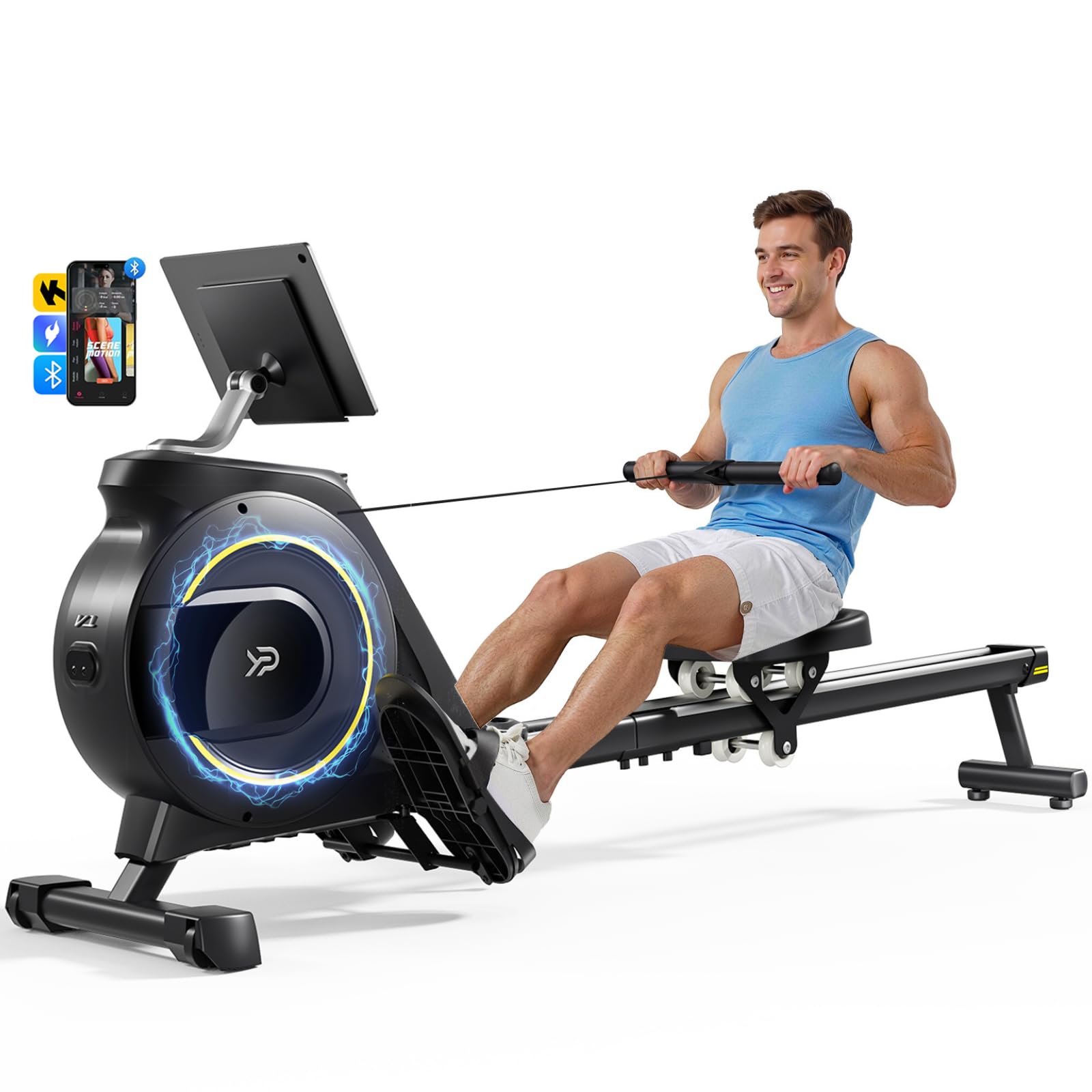
3. YPOO Rowing Machine
No plug, no battery swap — just pull and the display lights up.
The YPOO rower’s standout trick is that it requires no outlet or charging. It generates its own power as you row — the moment you pull, the LED display lights up with your time, distance, SPM (strokes per minute), and calories. That’s a meaningful convenience for anyone who doesn’t want to run extension cords across a room or replace batteries. The magnetic resistance keeps operation under 25dB, which is whisper-quiet territory — ideal for shared walls.
The 46-inch dual slide rail accommodates users from 4’5″ to 6’3″ with a 350-pound max capacity. At just 40.1 pounds, it’s the lightest of the rowers here, and the built-in transport wheels make it easy to roll into a corner for upright storage. The compact footprint is 2.9 square feet, which is smaller than the MERACH’s storage footprint. Construction uses a heavy-duty steel frame with a textured handle that stays grippy when sweaty and adjustable foot straps. The LED smart knob display is simple but effective, and it connects to the YPOOFIT and Kinomap apps for structured workouts.
The quality is the top praise from owners — 67 mention it. Assembly is the second most discussed aspect, with most owners getting it done in about 20 minutes, though some note the instructions need a second read. A few owners mention that the device holder doesn’t securely hold thicker phone cases and that the foot strap velcro is longer than ideal, making it a bit fiddly to tighten. One owner who bought it as a budget option for iFIT app users found it comparable to a Concept2 at resistance levels 5 through 9, which is high praise for the price.
Why it stands out
- Self-powered design means zero cords — row and the LED display turns on instantly
- At 40.1 pounds and under 3 square feet stored upright, it’s the most space-efficient rower here
- Owners who have used Concept2 machines say the resistance at levels 5-9 feels comparable
The small compromises
- Device holder isn’t secure with thick phone cases — plan on using a slim case or setting your phone aside
- Foot strap velcro runs long, making it trickier to cinch tight than traditional laces
- Some assembly instructions require a careful second read to get the seat installation right
Best for the cord-cutter: No plug, no batteries to swap, whisper-quiet magnetic resistance, and a footprint small enough for a bedroom corner. This is the rower for tight spaces.
skip it if: you want a large, high-resolution display or need a device holder that accommodates a thick protective case.
4. pooboo Elliptical Machine
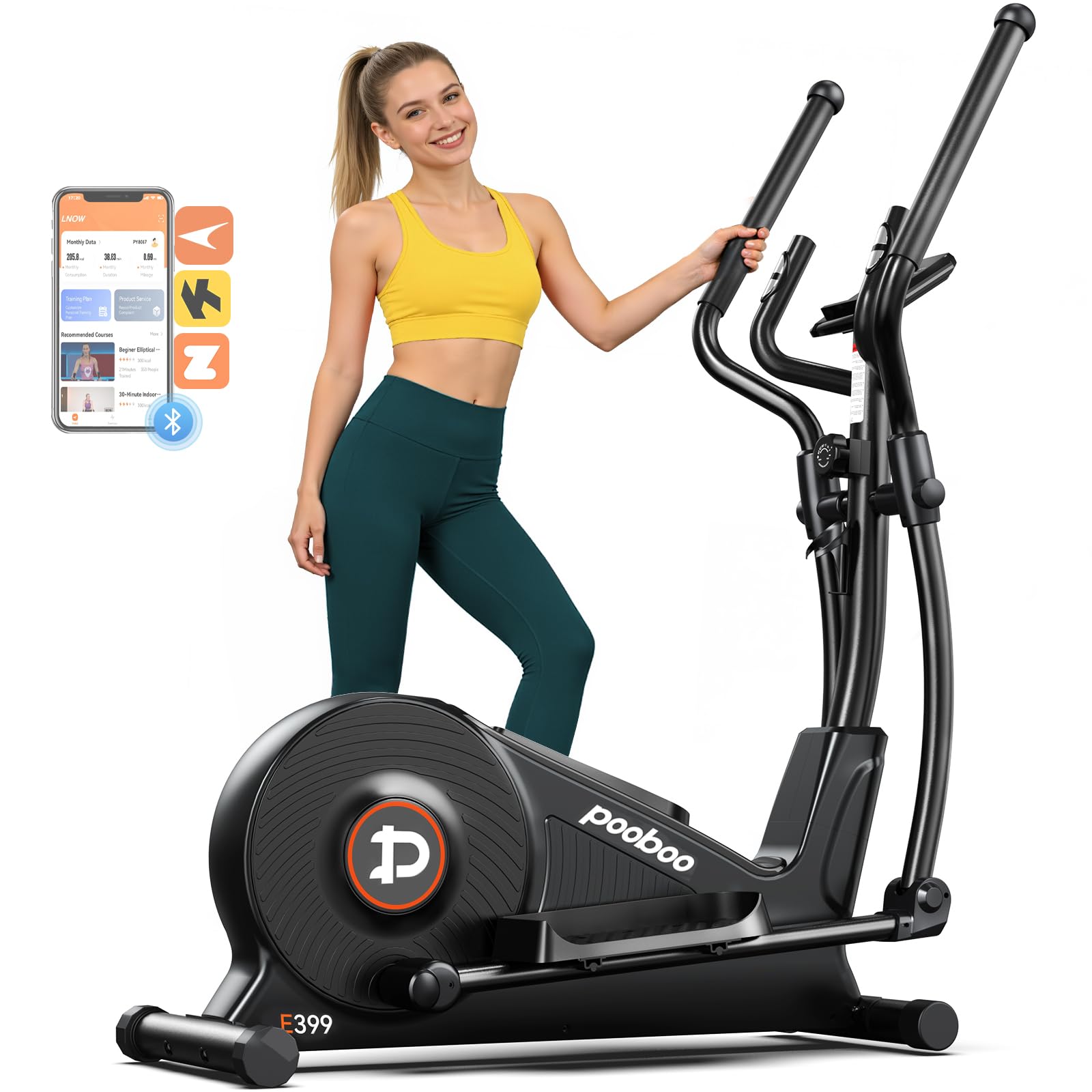
A rear-drive elliptical that glides silently and folds away.
The pooboo elliptical uses a rear-drive magnetic system — the 16-pound flywheel sits at the back, shifting the center of gravity for a safer, more stable feel. The 15.5-inch stride simulates a natural walking motion, and the extra-wide, non-slip pedals give you room to find a comfortable stance. It works in both forward and reverse, which is a nice way to target different muscle groups without changing machines. The noise level is rated at 20dB — quiet enough that neighbors won’t hear a thing.
The thickened steel pipe frame supports up to 350 pounds and fits users up to 6’5″. The LCD monitor tracks time, speed, distance, calories, pulse, and odometer readings, plus it’s compatible with Kinomap and ZT apps for more interactive workouts. The foldable design with transport wheels is a practical advantage — you can collapse it and roll it into a corner when guests come over. Assembly is the most-discussed positive, with 135 owners praising it, and the overall quality ranks second with 114 mentions. Most customers note 30 to 45 minutes of assembly time, especially with the aid of a video guide, though the written instructions get mixed marks.
As owners note, a 120-pound user notices some bounce at higher speeds, while a 175-pound user does not. A few owners found that an initial noise from the joints went away after applying WD-40. The display shows distance in kilometers by default, and some wish it showed RPM. But the overwhelming consensus is that this elliptical is sturdy, quiet, smooth, and an exceptional value for a home gym — one owner bought a second unit from the same brand because the first one held up so well.
The rear-drive advantage: The magnetic rear-drive system keeps the machine stable and quiet while delivering a smooth, natural stride. It’s foldable, app-compatible, and among the most praised ellipticals in this price range for assembly ease and build quality.
Reach for this if: you want a quiet, smooth elliptical that folds up when guests come over and can handle taller users up to 6’5″.
Think twice if: you weigh under 130 pounds — a few lighter users notice some bounce at faster paces. A heavier flywheel or slower stride might feel more planted.
5. MERACH Recumbent Exercise Bike
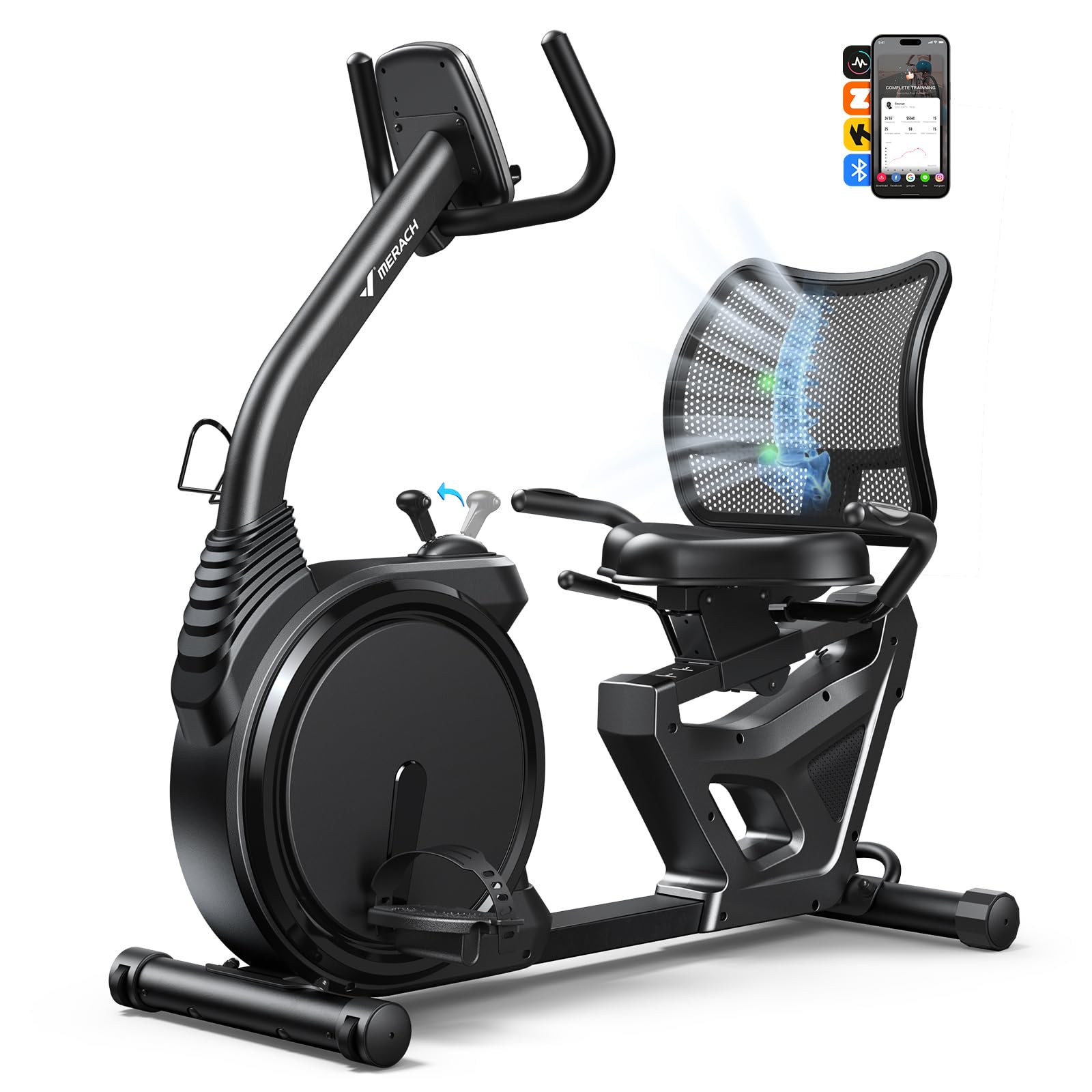
A recumbent bike that treats your back as well as your legs.
Recumbent bikes put you in a reclined, supported position that takes pressure off your lower back and wrists — a major selling point for seniors or anyone recovering from an injury. The MERACH S19 takes this seriously with a breathable mesh backrest and a thicker seat that adjusts to 8 different positions, accommodating leg lengths from 28.35 to 35.43 inches. The recommended height range is 5’2″ to 5’10”, so check your proportions before buying. The magnetic resistance has 8 levels controlled by a simple shift lever, and the 6.6-pound perimeter-weighted flywheel keeps pedaling smooth and silent.
Assembly is the most praised feature — 159 owners mention it, and the bike arrives 80% pre-assembled with a video guide so you can have it running in about 30 minutes. The LCD display shows time, distance, speed, calories, and heart rate (via the included hand-grip sensor). It connects to the MERACH app for real-time tracking, and the FantomFite app gamifies your cycling. The frosted handlebars resist sweat and provide a secure grip, which is a thoughtful upgrade from basic plastic handles. The build quality gets 99 mentions, and the comfort ranks third with 112.
Owners who compared it to a NordicTrack say the MERACH pedals more smoothly and quietly. The seat is a point of debate — some find it supportive, while others call it rock-hard and recommend an extra cushion. The display constantly scrolls through metrics rather than showing them all at once, which some find annoying. But the 708 ratings averaging high marks tell the story: this is a compact, sturdy, comfortable recumbent bike that delivers noticeable results within a week of use, according to several owners.
What works
- Mesh-back seat with 8-position adjustment offers genuine comfort for longer sessions
- Assembly is straightforward — 80% pre-assembled, video guide included, 30-minute typical build
- Bluetooth app connectivity with gamified riding keeps workouts interesting
What to know
- Seat firmness is polarizing — some owners strongly recommend an additional gel cushion
- LED display scrolls through metrics rather than showing them simultaneously
- Best for shorter users — the recommended height tops out at 5’10”; taller riders may feel cramped
Ideal for: anyone who wants a seated, back-supported cardio workout that’s easy to mount and dismount, especially seniors or those with lower-back concerns.
Not ideal for: tall riders over 5’10” or anyone who needs a non-scrolling display they can read at a glance.
6. UREVO Auto Incline Walking Pad
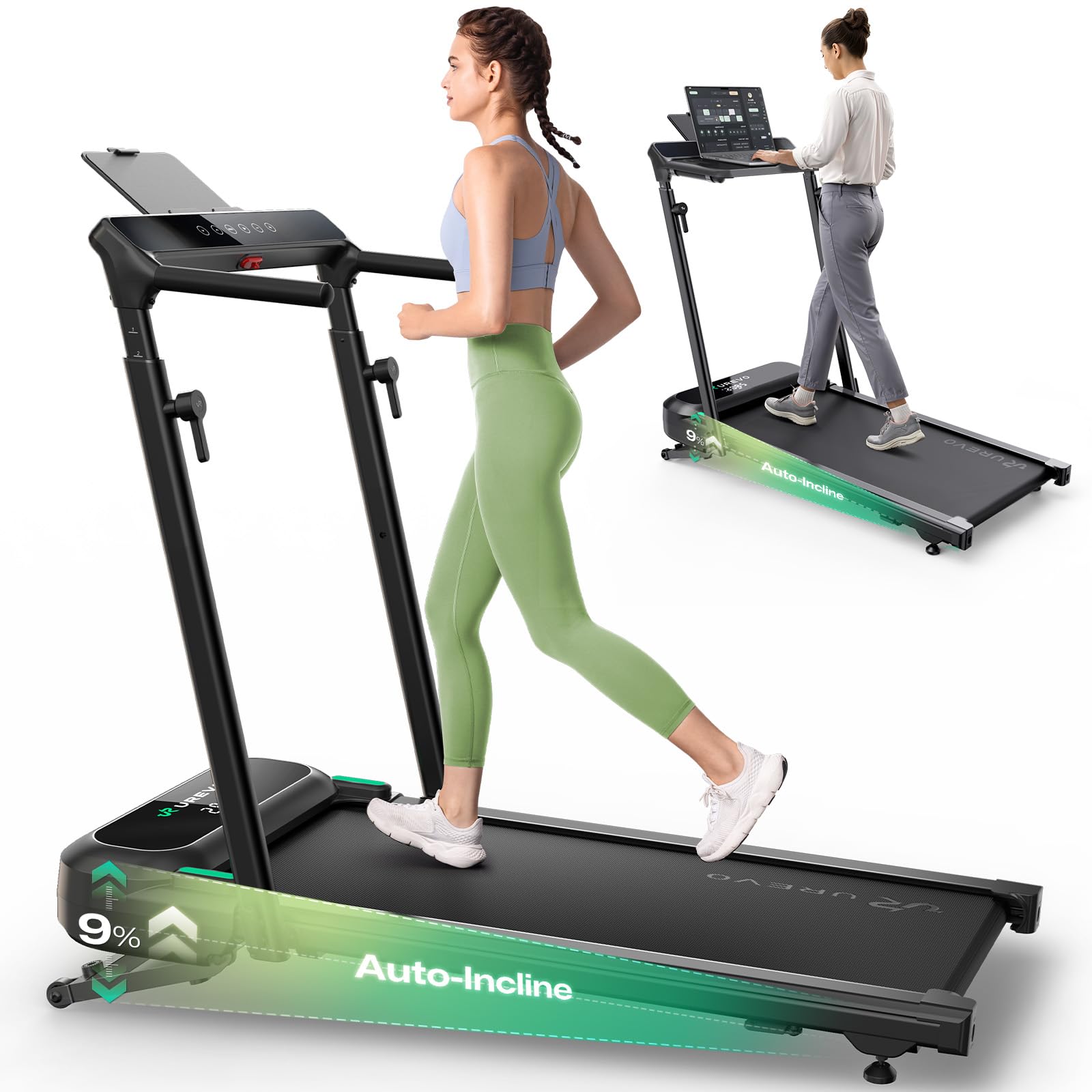
An under-desk treadmill that takes you from walking to hiking without leaving your home office.
The UREVO walking pad is a 4-in-1 machine designed for walking, jogging, climbing, and running, with speeds from 0.6 to 7.6 mph. The headline feature is the 9-level, 9% auto incline — a pro-level capability that lets you simulate hill climbs without a massive machine. The 3.0HP dual brushless motor powers the belt quietly enough that reviewers point out a slight whooshing sound that doesn’t register on phone calls. The 400-pound weight capacity is the highest of any machine here, beating even the heavy-duty Concept2 rower.
At 75 pounds and measuring 52.4 by 24.6 inches, this isn’t a lightweight walking pad — it’s a serious piece of equipment. The adjustable handlebar height is a rare feature that lets you match the machine to your own height. The 12-point shock absorption system uses 8 silicone points plus a suspended running board and 4-point support to protect your joints. The hidden LED display keeps your stats visible without being distracting, and the UREVO app tracks time, speed, distance, and calories. You control everything via the remote or the app.
Assembly is tool-free and fast — owners call it easy right from the start. The wide, long track gets consistent praise for feeling stable during both walking and jogging. A few owners mention that the machine is heavy to move around despite the 360-degree wheels, and the lack of an auto-off feature when you step off means you’ll need to remember to hit stop. The remote’s beeping cannot be silenced, which some find annoying during calls. But the consensus is clear: for under-desk use, it’s a quiet, reliable way to stay active while working.
The desk-friendly climber: A 4-in-1 walking pad with a 400-pound capacity, 9% auto incline, and a 3.0HP brushless motor that’s quiet enough for office calls. The 12-point shock system and adjustable handlebar make it more versatile than most walking pads.
Best for: remote workers who want to walk or climb while on calls, and anyone who wants a machine that doubles as a desk-compatible treadmill with real incline capacity.
Consider the trade-off: at 75 pounds, it’s not a quick-move machine; the remote beeps and the lack of an auto-off when you step off take some getting used to.
7. BORGUSI Treadmill
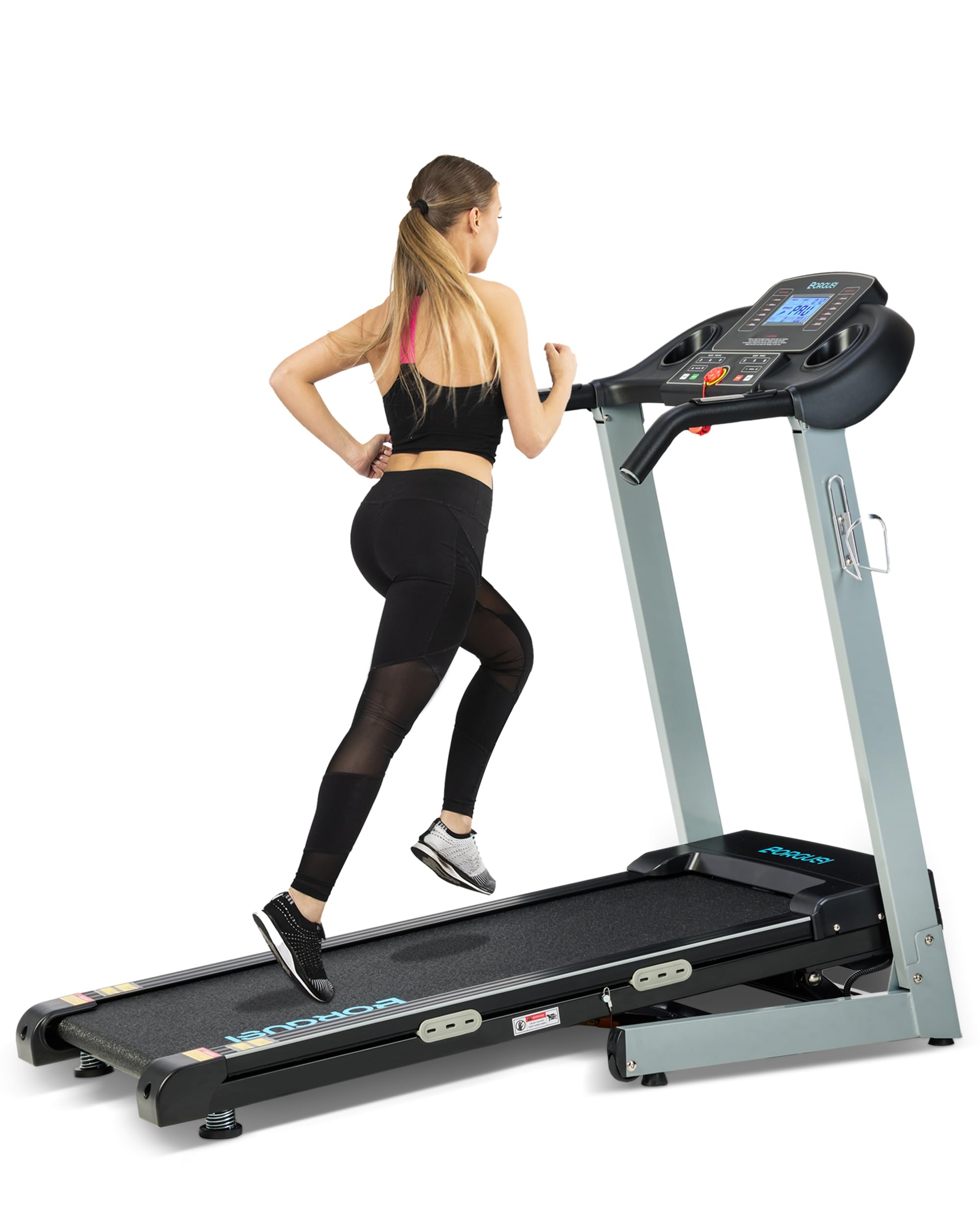
A solid, straightforward treadmill that’s been running quietly for years in owner homes.
The BORGUSI treadmill is among the most-reviewed machines here with over 950 ratings, and the story owners tell is consistent: it’s sturdy, quiet, and surprisingly reliable over the long haul. Several shoppers say using it heavily for two to three years without any wear issues. The 3.0HP motor powers speeds up to 8.5 mph, and the 15% auto incline gives you real hill-training capability. The 17.5-inch by 45.3-inch belt is wider and longer than many budget treadmills, reducing the feeling of being cramped during a run. The heavy-duty tubular steel frame handles up to 300 pounds.
One-touch buttons on both handrails let you adjust speed and incline without reaching for a console, which is a nice safety touch when you’re at a full run. The large blue backlit LCD display shows time, speed, distance, calories, incline, and pulse, plus there are 15 preset programs to vary your workouts. Bluetooth speakers let you stream music from your phone. The folding frame with a soft-drop system makes storage manageable — at 105 pounds it’s not light, but the transport wheels help. Assembly is 90% pre-assembled, and most owners finish in under 20 minutes.
The shock absorption uses 10 internal absorbers to protect knees and joints, and owners confirm it’s gentle enough for daily use. A couple of owners note that the machine has an inherent 2 to 3-degree ergonomic slope, which the manufacturer acknowledged as intentional. The display sits at waist level rather than eye level, which takes some getting used to. But the value equation here is strong — owners consistently say it holds up against pricier models for a fraction of the investment.
Long-term strong suit
- 17.5-inch wide belt and 8.5 mph top speed accommodate most runners comfortably
- 15% auto incline gives genuine hill-workout capability without manual adjustment
- Multiple buyers report reliable daily use over 2-3 years with no mechanical issues
Minor quirks
- Display sits at waist level, not eye level — you’ll glance down rather than straight ahead
- At 105 pounds, moving it upstairs or repositioning alone is a challenge
- Some owners note the machine has a slight built-in slope (2-3 degrees) by design
Your first real treadmill: If you want a foldable, auto-incline treadmill with a wide belt, Bluetooth music, and a reputation for holding up over years of use, this is a very strong mid-range pick.
Not for you if: you need eye-level display positioning or a machine you can easily carry upstairs alone — at 105 pounds with transport wheels, you’ll want a helper for stairs.
8. YOSUDA 3-in-1 Elliptical Machine
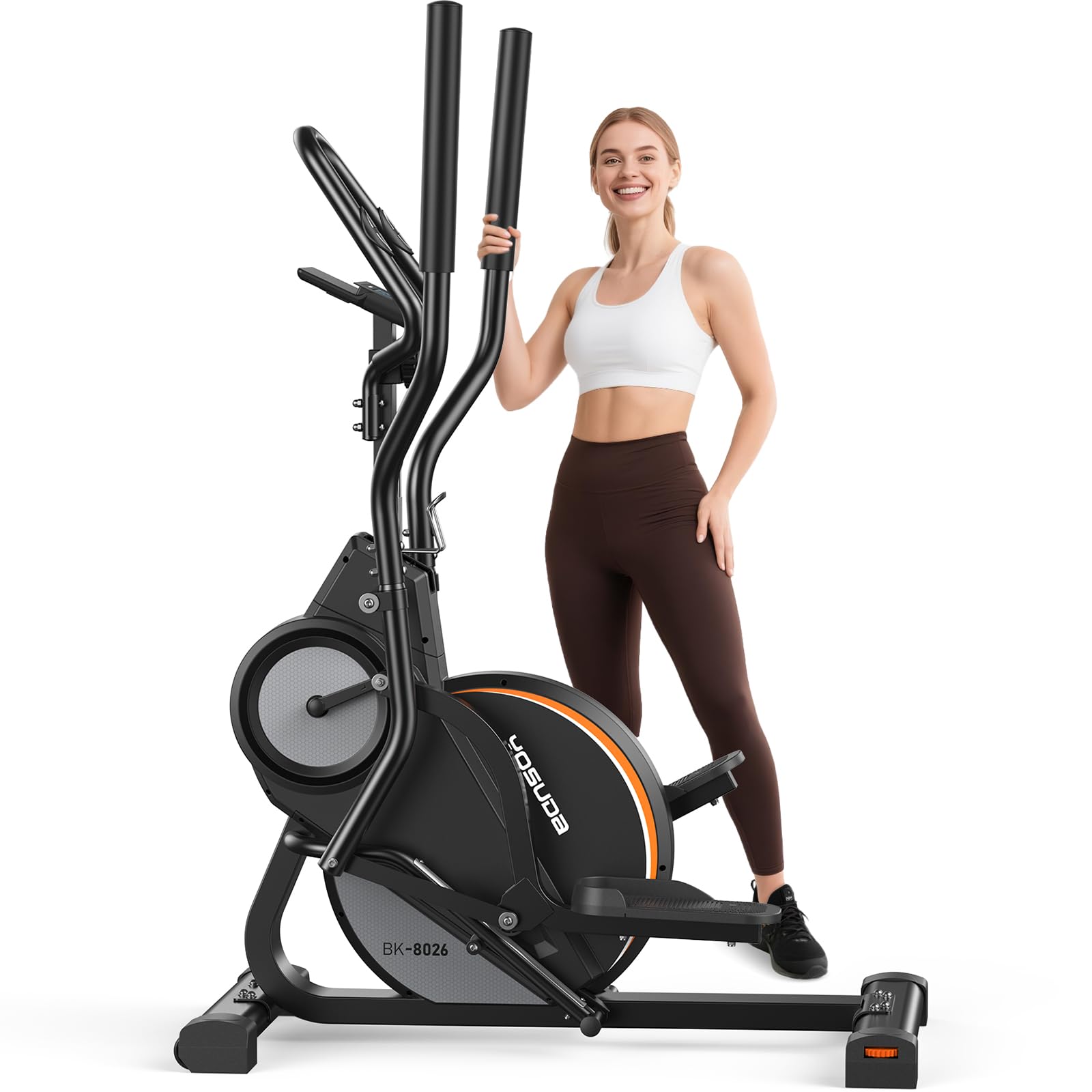
Three machines in one: an elliptical, a stair stepper, and a cardio climber that targets your glutes and core.
The YOSUDA DSJ-01 isn’t your standard elliptical. It integrates elliptical, stepper, and cardio climber functions into a single compact frame with a 45-degree climbing angle. That incline simulates a real outdoor climbing posture, engaging your hips, glutes, legs, waist, and core more directly than a flat elliptical. The 18-pound heavy-duty flywheel provides stable inertia — basically, it keeps the pedals moving smoothly so you don’t feel choppy transitions. The magnetic silent control system keeps the operation quiet enough for use in any room.
With 16 levels of precise resistance and a 300-pound capacity, it fits a wide range of fitness levels. The 15.5-inch stride is generous for a compact machine, and it occupies just 5.38 square feet of floor space. A 5’7″ owner reports large pedals that feel stable, and the built-in front wheels let you roll it where you need it — though at 94.6 pounds, “roll” is the right word, not “carry.” The digital monitor tracks calories, time, speed, distance, odometer, and pulse, and the Bluetooth connection works with Kinomap and Fed App for guided workouts.
The assembly is the number-one challenge here — many owners call the instructions confusing and recommend finding a YouTube video. One owner reports receiving a wrong part and breaking a screw during assembly, though the seller sent replacements within three days. Once assembled, the machine is described as silent, sturdy, and effective. The machine more closely mimics a stair-stepper than a traditional elliptical, which is exactly what YOSUDA intended. Several owners note that 5’1″ users find the stride comfortable, and 5’11” users also report a stable workout — an impressively wide fit range.
The space-saving triple threat: A 3-in-1 elliptical, stepper, and climber with a 45-degree climbing angle that activates more muscle groups than a flat elliptical. The 5.38-square-foot footprint and front transport wheels make it practical for small homes.
Reach for this if: you want a compact machine that climbs, stepps, and ellipticals in one, targeting your glutes and core more aggressively than a standard elliptical.
Prepare for the build: assembly is the weak point — budget extra time and look up a video guide before you start. The reward is a quiet, rugged climber that blends into a corner.
9. Sunny Health & Fitness Elite Recumbent Cross Trainer

A recumbent cross-trainer that combines upper and lower body work in one seated, joint-friendly motion.
The Sunny Health & Fitness Elite is a recumbent elliptical cross-trainer, which means you sit in a supportive reclined seat while your legs pedal on large elliptical foot pedals and your arms push and pull movable handles. That simultaneous upper and lower body engagement is a key advantage over a standard recumbent bike — you’re getting a true full-body workout while staying seated. The electromagnetic resistance system has 16 levels, plus 12 pre-programmed workouts and the ability to create 4 custom user programs. That’s a level of programmability that set-and-forget machines don’t offer.
The padded seat with a contoured mesh backrest adjusts without requiring you to dismount — just engage the handle by your side and slide. The easy on-off design with minimal obstruction between the handlebars and seat makes it safer for anyone with balance concerns. At 113.1 pounds and measuring 71.7 by 33.3 inches, this is a substantial machine, so plan for a dedicated spot. It requires a plug for the electronic resistance and programs, unlike self-powered alternatives. The performance monitor tracks time, speed, RPM, distance, watts, calories, heart rate, and target heart rate. The free SunnyFit app gives you access to over 1,000 trainer-led workouts and 10,000 virtual scenic tours without any membership fees.
Assembly is the biggest hurdle — owners mention it takes about 1.5 to 2 hours with two people, and the diagrams are small. One owner had a pulley belt issue that was resolved quickly by customer service. Owners praise the sturdiness, noting no wobble even at high resistance, and the smooth, quiet motion. The pedal distance is relatively short, which means it’s not ideal for hardcore athletic training, but for low-impact recovery, hip bursitis relief, and daily cardio that doesn’t punish your joints, it’s exceptional. A 6’4″, 310-pound owner reports fitting with room to spare.
Full-body advantage
- Moveable handles let you work arms and legs simultaneously, or isolate either for targeted training
- 12 preset programs plus 4 custom user profiles provide real workout variety without app dependency
- The SunnyFit app is genuinely free — no membership fees for 1,000+ workouts and scenic tours
Practical realities
- Assembly takes 1.5 to 2 hours with two people — clear a block of time and have a helper
- Requires a wall outlet for electromagnetic resistance and program features
- Pedal stride is shorter than a gym elliptical; serious athletes may outgrow it
Best for: anyone who wants a seated full-body workout with tons of program options — especially valuable for rehabilitation, low-impact training, and older adults who want upper body engagement without standing.
Consider the setup time: this is not a 20-minute assembly project. If you don’t have two hours and a helper available, budget for assembly assistance or choose a simpler machine.
10. NordicTrack T Series Treadmill
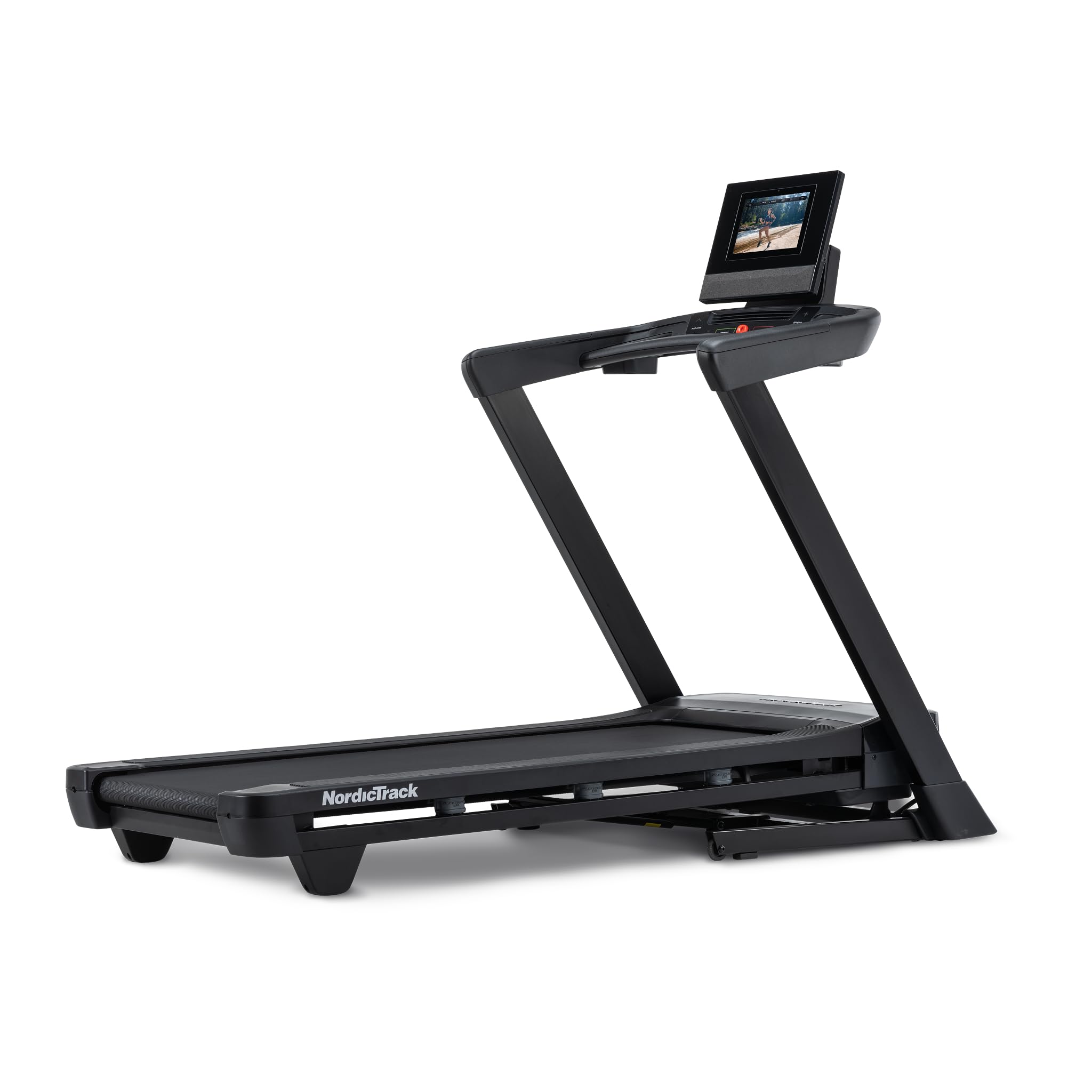
A connected treadmill built around the iFIT ecosystem, from scenic runs to AI coaching.
The NordicTrack T Series is designed to be the centerpiece of an iFIT-powered workout routine. The 10-inch tilting touchscreen lets you follow studio classes, off-treadmill workouts like yoga and strength training, and stream shows and movies — all through an iFIT Pro Membership ( per month). The machine itself is a solid performer: speeds from 0 to 12 mph, incline from 0 to 12%, and a 60-inch by 20-inch running deck that’s spacious enough for comfortable strides. The SelectFlex cushioning lets you adjust the deck from soft to firm, absorbing impact whether you’re walking or running. The 3.6 CHP motor is powerful enough for daily running without bogging down.
The ActivePulse feature uses a Bluetooth heart rate monitor (sold separately) to automatically adjust speed and incline to keep you in your ideal heart rate zone. SmartAdjust learns your performance and evolves your workouts over time. The folding frame with the soft-drop foot bar is designed for small spaces — folded, it measures 60 by 30 by 12 inches. It syncs with Strava, Garmin Connect, and Apple Health for unified tracking. The AI Coach can create plans and load your next workout directly to the machine’s home screen.
The quality is the most-praised aspect — 152 owners highlight it. The value for money ranks second, and the sturdiness ranks third. That said, assembly gets mixed feedback: some find it straightforward with a helper, others find it frustrating. The biggest frustration voiced by several owners is the iFIT subscription structure — one owner reports that the map feature worked for three months before an update restricted it to the /month Pro tier. Others swear by the iFIT programs and find the subscription worthwhile, viewing the content as the main reason to buy the machine. The incline mechanism is audible, making a gym-like noise during adjustments, which is normal for this type of machine.
The iFIT gateway: A quality treadmill with a 10-inch touchscreen, 0-12% incline, SelectFlex cushioning, and deep iFIT integration. The 60-inch deck is genuinely spacious, and the folding design is apartment-friendly.
Reach for this if: you’re already an iFIT user or excited about connected, coach-led workouts, interactive scenic runs, and automated resistance/incline that adjusts mid-class.
Think twice if: you don’t want a monthly subscription to access the machine’s connected features — manual mode works, but the core value is in the iFIT ecosystem, and you’ll need that /month membership to open up it fully.
11. Teeter FreeStep LT7 Recumbent Cross Trainer

A physical therapy-grade stepper for anyone whose knees and back say no to traditional cardio.
The Teeter FreeStep uses a patented vertical stepping motion licensed from commercial physiotherapy steppers. Its patented natural stride is licensed from commercial physiotherapy steppers — the same kind you’d find in a PT office. Instead of the circular pedaling of a bike or the forward stride of an elliptical, this machine uses a vertical stepping motion that aligns your joints for better muscle engagement with less stress on hips, knees, and ankles. The zero-impact design is specifically noted as beneficial for those with arthritis, Parkinson’s, or MS. The recumbent seated position with the Extra-Large ComfortMax Seat and the SureGrip handles with polyurethane coating prioritizes comfort and stability above all else.
The 20-level magnetic resistance (controllable via console quick-keys from 0 to 105 pounds of resistance) gives you friction-free, whisper-quiet performance — owners consistently call the operation silent. The 9-inch color LCD screen shows 7 tracking metrics and includes 21 pre-programmed, goal-based workouts, plus Bluetooth compatibility with a heart rate monitor (sold separately). The media rack with USB charging and adjustable height means you can follow along with classes or watch shows during your session. The Electronic Step Lock makes entry and exit feel safe, and the dual cup holders are a practical touch. The Teeter Move app is free and subscription-free, with a library of trainer-led workouts that vary in length and intensity.
Assembly is thesecond most-discussed positive — 46 owners praise it, and most report completing the build in about an hour with clear instructions. The quality tops the list with 47 mentions. The machine is rated for users from 4’11” to 6’6″ with a 350-pound capacity, which is an impressively wide range. At 150 pounds and measuring 59 by 32.7 inches, this is a substantial machine for a dedicated space. Some owners note the compact length feels a bit short, and the seat doesn’t swivel, making access a minor challenge for some. But the overwhelming verdict is that it’s superbly built, silky smooth, and feels like a much more expensive machine.
Joint-saving design
- Patented physical therapy stride aligns joints for less stress on hips, knees, and ankles — owners with active arthritis and back pain report real relief
- Whisper-quiet magnetic resistance with 20 levels (0-105 lb) provides friction-free, long-lasting performance
- Free Teeter Move app with no subscription — a rarity among connected home fitness machines
Space and weight
- At 150 pounds and 59 inches long, this is a dedicated-floor-space machine — not something you stash in a closet
- Seat doesn’t swivel, making entry and exit less convenient than a traditional recumbent bike
- Compact stride length feels short for taller users — the motion is more vertical stepping than a long elliptical glide
Built for recovery: If you have bad knees, back problems, or joint sensitivity that rules out other cardio machines, the Teeter FreeStep is worth every square foot of its footprint. The PT-inspired motion is genuinely unique.
Only if you have the room: At 150 pounds and 59 inches, this is a “set it and leave it” machine. Plan where it goes before it arrives, because you won’t be moving it around easily.
Understanding the Specs
Resistance Type: Magnetic vs. Air vs. Electromagnetic
Magnetic resistance uses magnets to create drag without physical contact between parts — it’s nearly silent and essentially maintenance-free, making it the go-to for home use. Air resistance (like the Concept2 rower) uses a fan wheel: the faster you move, the more air you push, and the harder the workout gets. It’s louder but gives a fluid, natural feel. Electromagnetic resistance is magnetic resistance controlled by electronics, which allows the machine to automatically adjust resistance mid-workout based on app cues or heart rate data. It’s the most sophisticated but requires a power source.
Stride Length & Weight Capacity
Your height dictates how comfortable a machine feels. For ellipticals and rowers, a stride length of 15.5 to 18 inches fits most adults; anything shorter can feel cramped for tall users. Recumbent bikes are measured by seated leg length — check the extended leg measurement against your inseam. Weight capacity is your safety margin: a machine rated for 300 pounds is built with heavier-duty bearings and frame welds than one rated for 250. If you’re near the listed limit, go up a tier for stability and longevity.
Footprint and Storage
Measure your intended space including clearance behind and to the sides — a treadmill needs about 6 feet of length and 3 feet of width for safe use, plus room to dismount. Rowers need about 8 feet of floor length when fully extended, though many store upright or break into two pieces. Ellipticals and recumbent bikes are more compact but rarely fold completely flat. Look for transport wheels on anything over 50 pounds — dragging a 100-pound machine across carpet is a recipe for frustration.
Smart Features and App Connectivity
Bluetooth app connectivity can transform a basic machine into a guided training tool. The best apps (Kinomap, iFIT, MERACH, SunnyFit) offer structured workouts, scenic routes, and progress tracking. But some features require ongoing subscriptions — the NordicTrack iFIT Treadmill, for example, needs the /month Pro Membership for full interactive content. Others, like the SunnyFit and Teeter Move apps, are genuinely free. Decide if you want a “dumb” machine with a simple LCD or a connected coach before you buy, because the subscription costs can quickly exceed the machine’s price over a few years.
FAQ
Which cardio machine is gentlest on bad knees?
How much floor space do I need for a rowing machine?
Is a walking pad as good as a treadmill for running?
Do I need a subscription for the iFIT treadmill features?
What does “self-powered” mean on a rowing machine?
How long should assembly take for home cardio equipment?
Which machine works best for weight loss?
Are recumbent bikes better than upright exercise bikes?
How do I maintain my home cardio equipment?
Can I put a treadmill or rower on a second floor or in an apartment?
Final Thoughts: The Verdict
Across the board, the best cardio equipment for home is the Concept2 RowErg because it delivers a full-body, low-impact workout that serious athletes and casual users both love, backed by a 500-pound capacity, a 5-year frame warranty, and a decades-long reputation for durability. If you want a whisper-quiet rower that stores upright and won’t wreck your budget, grab the MERACH Magnetic Rower. And for anyone with joint pain who needs a seated, zero-impact machine that feels like physical therapy, the Teeter FreeStep LT7 is the one to reach for — it’s a big investment in space and money, but owners with bad knees and backs say it’s worth every square inch.
How We Picked
We do not accept paid placement. Every pick is matched to a real buyer and a real use-case; we do not hands-on test units.
Sources & Methodology
Specifications: manufacturer listings and product documentation. Review insights: verified customer reviews, as of July 2026. Pricing: not shown on this page (it changes often); check the current price via the retailer link.
As an Amazon Associate, Snuggy Mom earns from qualifying purchases. This does not affect which products we feature.