
Specs are compiled from manufacturer listings and verified buyer reviews and can change over time — please confirm the key details on the product page before buying.
Shin splints turn every step into a painful reminder that your feet are the foundation of everything. When that sharp ache travels up your shin, the fix is rarely in your leg — it is almost always in your arch. The right arch support changes your stride angle, unloading the tendon and muscle that cause shin pain.
I’m Emma — the founder and writer behind Snuggy Mom. This guide is built by comparing the manufacturers’ published specifications and the patterns across verified customer reviews, so you get each pick’s real strengths and trade-offs instead of marketing spin.
Whether you are battling plantar fasciitis on top of shin pain or just need something that lets you walk through a workday without wincing, the honest difference between relief and regret depends on one thing: finding the best arch support for shin splints that actually matches your arch height, your weight, and your daily miles.
Our Picks at a Glance

How To Choose The Best Arch Support For Shin Splints
Shin splints are a stress reaction where the muscle pulls on the bone. Proper arch support shortens that lever arm and reduces the pull. You want an insole that holds your arch at a healthy height, absorbs ground impact, and keeps your heel stable to prevent overpronation.
Arch Height and Your Foot Type
A low arch or flat foot tends to collapse inward, which torques the shin muscle. A high arch is rigid and doesn’t absorb shock, sending vibration straight up the leg. Pick an insole that matches your actual arch — low-arch insoles cradle a fallen arch, while high-arch insoles fill the gap under a rigid foot. The wrong height makes shin pain worse, not better.
Rigidity vs. Cushioning
Soft foam collapses fast under a heavy stride. Semi-rigid support holds your arch in position while allowing natural foot flex. For shin splints, look for a firm shell or a structured heel cup — the stability matters more than the pillow feel.
Heel Cup Depth
A deep U-shaped heel cup locks your heel bone in place. This prevents your foot from sliding and keeps the arch support exactly where it needs to be. A shallow cup lets your foot wander, which defeats the purpose of the insole.
Weight Rating and Durability
Some insoles are built for a specific weight range — heavy-duty models designed for over 220 lbs use denser foam and a thicker shell. If you are over that threshold and buy a standard insole, it flattens in weeks and your shin splints return. Match the rating to your body weight for support that lasts.
Quick Comparison
| Model | Best For | Arch Focus | Weight | Key Material | Amazon |
|---|---|---|---|---|---|
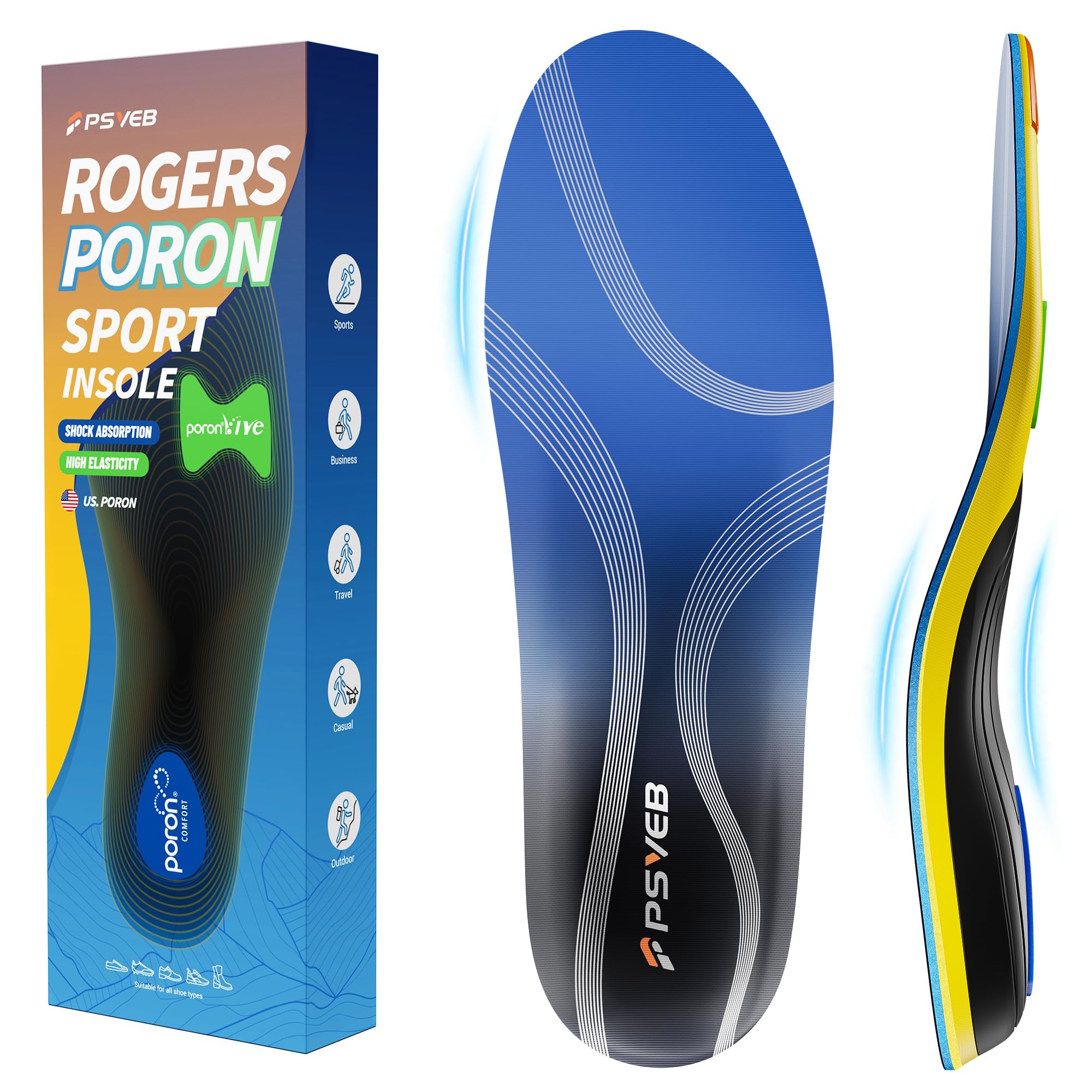
| Professional Heavy Duty Support★ Best Overall | Heavy-duty all-day relief | Medium | 8.15 oz | Dual PORON + PU | Amazon |
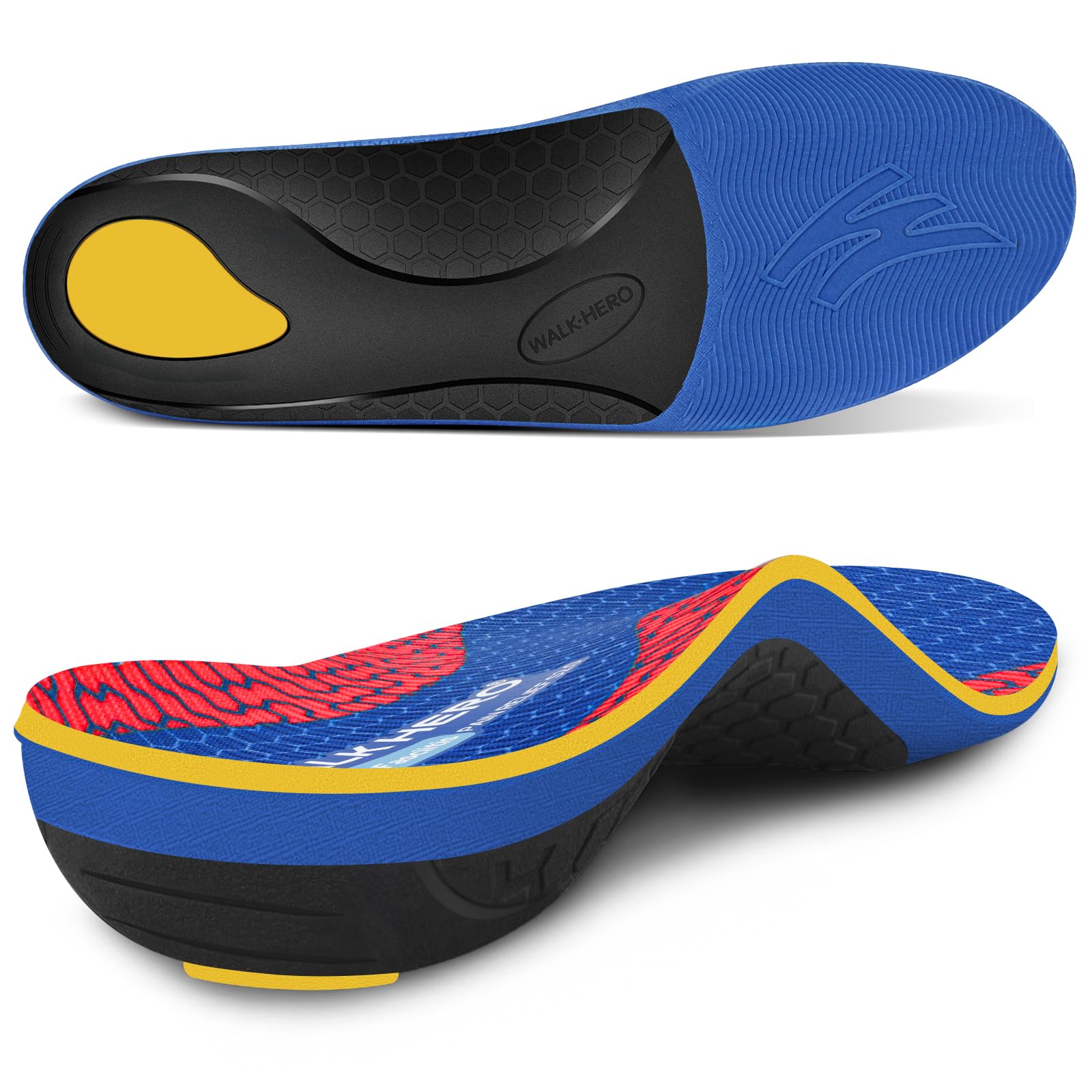
| WalkHero Plantar Fasciitis ReliefBest Value | Budget-friendly everyday wear | Semi-rigid | 5.61 oz | EVA + Foam + PU heel | Amazon |
| Inserts Relieve Plantar FasciitisBest for Distance | Long-distance walkers | Firm | 4.97 oz | Premium EVA | Amazon |
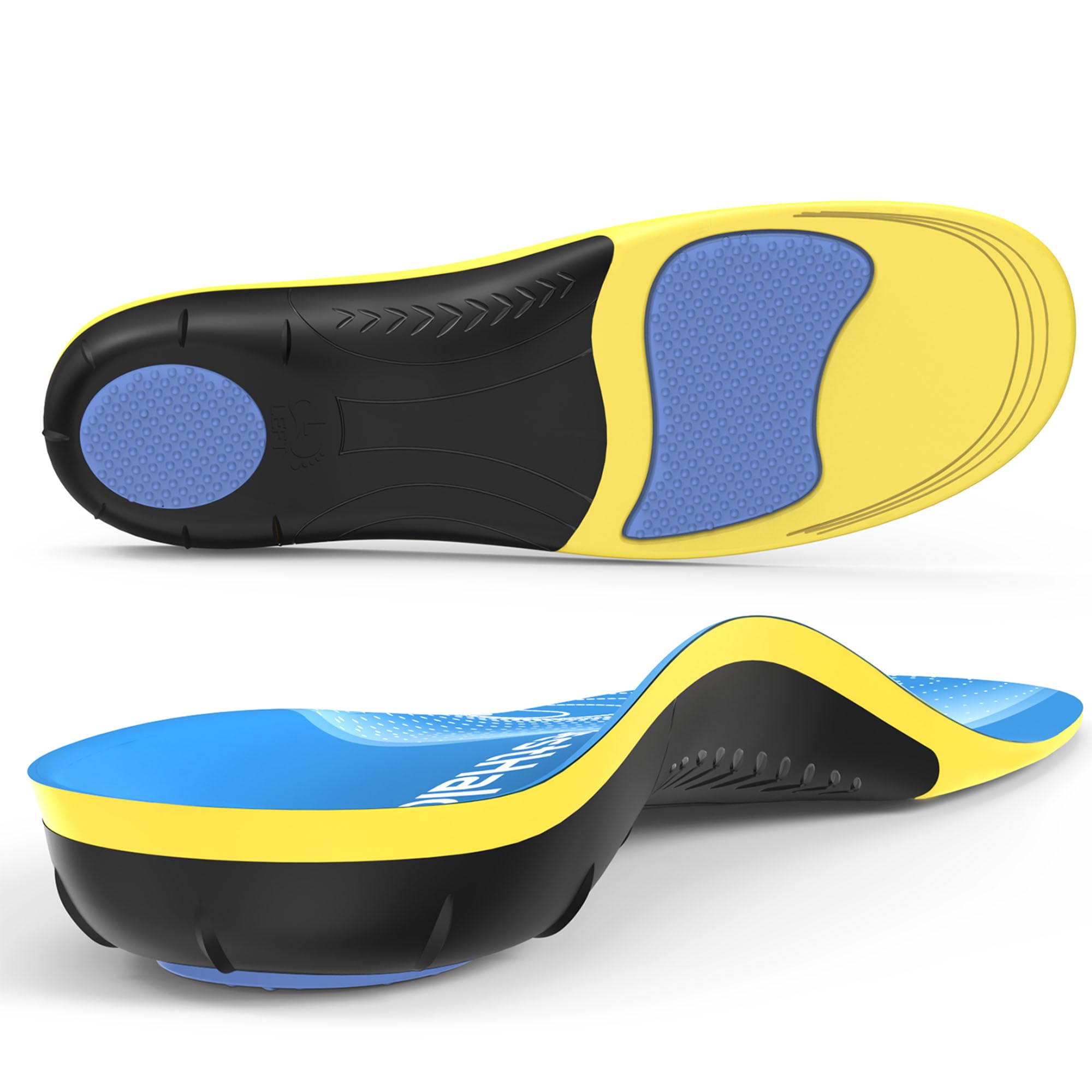
| BestHalo Heavy Duty | High arches & heavy users | High | 9.14 oz | EVA + Gel | Amazon |
| OUOKK 3/4 Length Arch Support | Tight shoes & high arches | High (30mm) | 5.61 oz | TPU elastic + Foam | Amazon |
| CRUVHEAL Sport Shock Absorbing | Basketball & high-impact sports | Neutral | 5.93 oz | Gel pads + EVA | Amazon |
| Superfeet Run Cushion Low Arch | Runners with low arches | Low | 4.83 oz | Adaptive Comfort Foam | Amazon |
| CURREX SupportSTP High Arch | Custom-fit & breathability | High (multi-profile) | 1.19 lbs (19 oz) | Premium Foam + Mesh | Amazon |
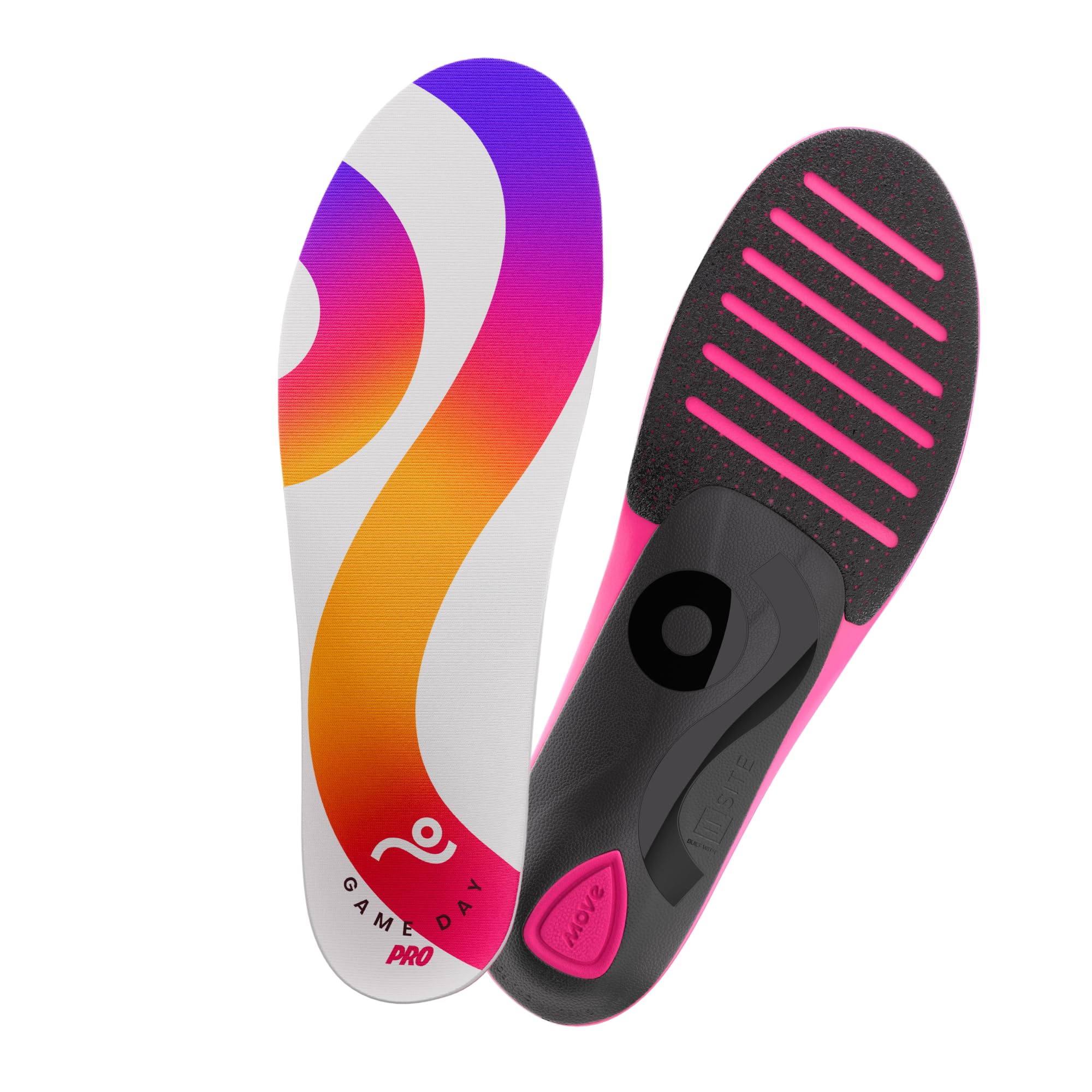
| MOVE Game Day Pro | Court sports & pro athletes | High | 4.16 oz | X-Frame TPU + Foam | Amazon |
In‑Depth Reviews
1. Professional Heavy Duty Support Pain Relief Orthotics – Over 230+ lbs
Our pick — 4.5★ from 950+ verified ratings; the strongest balance of quality and price.
The heavy lifter that takes the sting out of a full day on concrete.
This is the insole the crowd of 980+ owners keeps coming back to, and the reason is simple: it is built for people who cannot sit down. The double PORON cushioning (a high-performance foam that absorbs shock without losing shape) and the ergonomic ‘Golden Triangle’ design give you three points of support — forefoot, arch, and heel — so your shin does not take the brunt of every step. At 8.15 ounces, it is noticeably denser than the WalkHero model (which weighs 5.61 oz), and that density translates directly into stability for heavier frames.
What wins people over here is the comfort — mentioned by well over 140 owners — paired with the fact that it fits work boots and running shoes without needing a full break-in period. The trade-off is the bulk: a few buyers report that the insole takes up noticeable room inside the shoe. If you have narrow footwear, you may feel squeezed. But for anyone over 220 lbs who stands all day, this is the anchor that quiets the shin.
Why It Works for Shin Splints
- Dual PORON layers absorb impact before it reaches your shin
- Deep U-shaped heel cup locks the heel, preventing the overpronation that triggers shin pain
- Over 230 lbs weight rating means the support does not collapse mid-day
The Fit Caveat
- Bulky build can crowd tight shoes — best for wide or standard-fit footwear
Reach for this if: you are on your feet all day, carry a heavier build, or have tried softer insoles that went flat in weeks.
Look elsewhere if: your shoes are already snug and you cannot afford to lose any interior volume.
2. WalkHero Plantar Fasciitis Relief Inserts
Punchy arch support that sells for a fraction of what you would expect.
WalkHero packs a semi-rigid arch into a full-length insole that sits right in the balance between “too soft to help” and “too hard to wear.” The Tri-Layer Cushioning System uses high-density foam, an EVA layer, and PU shock-absorbing heel pads to take the edge off every heel strike — exactly the kind of impact dampening that calms shin splints over a long shift. Owners mention wearing these every day to work and finding they simply do not need to repurchase, which is a strong sign of durability at this price tier.
The deep heel cup does a solid job of stabilizing the foot, and the semi-rigid arch allows natural movement while still propping up a collapsing arch. The catch: a handful of owners find the cushioning too firm, especially if they are used to a plush walking shoe. If you prefer a cloud-soft feel, this is not it. For the buyer who needs reliable, no-nonsense arch support that does not break the bank, this is the one to beat.
Standout Strengths
- Excellent pain relief — the top-mentioned aspect, with over 40 owners calling it out
- Full-length support distributes weight evenly, reducing shin strain
- PU heel pads add targeted shock absorption for the heel strike
One Thing to Know
- Cushioning leans firm; not ideal if you want a plush, pillow-like insole
Grab this for: a daily driver that gives you semi-rigid support without a premium price tag.
skip it if: you need maximum softness under the ball of your foot.
3. Inserts Relieve Plantar Fasciitis – Flat Feet Insoles Arch Supports
The crowd favorite that eliminates foot pain for mile after mile.
With a staggering number of owners — nearly 75,000 ratings — this is the most-reviewed insole in the group, and the consensus is hard to argue with. The premium EVA material (a lightweight, closed-cell foam that absorbs shock well) provides firm arch support that does not squish out under pressure. Customers note that the insole eliminated foot pain after walks of five to eight miles, with one buyer calling it “best insoles ever” — a bold claim that is backed by the 2,800+ people who specifically mention pain relief as a standout feature.
The deep heel cup maintains correct foot positioning during the heavy impact of landing. This is critical for shin splints because a stable heel means the arch does not collapse mid-stride. The firmness is the dividing line here: some people love it, while others — especially those with heel pain alone — find it too hard. It is also note that a few owners mention the insole can wear down faster than expected, with the top layer peeling after a few weeks. For the price, most find it an easy trade-off.
Why Walkers Love It
- Comfort is the top praise — over 3,700 owners call it out
- Firm arch support stops overpronation, a common shin splint trigger
- Deep heel cup stabilizes the foot on long walks and runs
The Catch
- Stiffness is a mixed point — not for those who want a soft, cushioned step
- A handful of units show early wear on the top fabric layer
Choose this if: you log serious miles on pavement and want a proven, firm-arch insole that the community swears by.
Think twice if: your shin pain is paired with sensitive heels that need extra padding.
4. BestHalo Heavy Duty Plantar Fasciitis Insoles – 220+ lbs
High-arch structure that stands up to heavy use and heavier frames.
Designed specifically for individuals weighing 220+ lbs and those with high arches, the BestHalo insole uses a biomechanical design that promotes natural alignment. The premium EVA foam combined with gel cushioning delivers strong shock absorption — exactly what you need to stop impact from traveling up the shin. Owners rave about the arch support, with over 100 people calling it out, and many note that it virtually eliminated post-surgery pain that radiated from their feet to their hips.
The ergonomic deep heel cup helps control overpronation and supination (excessive inward or outward rolling of the foot), which is a common root cause of shin splints. But the high arch is not for everyone. A few buyers found the arch too high, and experienced new foot and lower back pain during the adjustment period. BestHalo recommends wearing them 2-3 hours daily for the first week. If you are sure you need high-arch support, this is a durable, effective pick.
Best for High Arches
- Specifically designed for high arches — not a one-size-fits-all shape
- Gel cushioning adds a layer of impact protection for shins and knees
- Heavy duty build (9.14 oz) holds up for users over 220 lbs
Consider This
- High arch can be too aggressive for medium or low-arched feet
- Requires a gradual break-in period of 3-7 days
Best for: heavy users with naturally high arches who need a rigid, structured insole that does not flatten out.
Not for: flat-footed walkers or anyone wanting a soft, immediate “sink-in” feel.
5. OUOKK 3/4 Length High Arch Support Inserts

The sneaky-thin insert that crams high-arch support into tight shoes.
Not every shoe has room for a full-length insole. The OUOKK insert is a 3/4 length design — meaning it stops before the toes — so it fits in loafers, flats, and snug sneakers where a thicker insole would crowd your foot. Despite the compact profile, it delivers a 30mm high arch support (measured from the base to the top of the arch) made from premium TPU elastic material, which is both firm and flexible. Over 70 owners cite foot pain relief as the top reason they keep buying these.
This is designed for medium to high arches, and the maker claims the support lasts for two years or more — a bold durability figure for a 3/4 insole. The trade-off is placement: because it is shorter, it can shift inside the shoe if the adhesive sticker loses grip. A few owners also note it is rigid, so if your arch is on the lower side, the 30mm height may feel like a mountain. For tight shoes and high arches, this is the cleanest solution in the list.
Why It Fits
- 3/4 length saves space in narrow or dress shoes
- 30mm arch height provides strong lift for high-arched feet
- TPU elastic material offers a balance of firmness and rebound
A Minor Friction
- Can shift in the shoe without a snug fit or good adhesive
- Too tall for anyone with low or medium arches
Reach for this if: you have high arches and tight shoes that cannot accommodate a full-length insole.
pass on it if: you have flat feet or want coverage all the way to your toes.
6. CRUVHEAL Sport Shock Absorbing Insoles

Built for the court, but quiets shins on the sidewalk too.
The CRUVHEAL is the only insole in this lineup that explicitly mentions shin splint prevention in its own feature list — specifically calling out how it minimizes the risk during high-impact activities. It uses strategically placed gel pads in the heel and forefoot to absorb impact, combined with a deep heel cup that stabilizes the foot during lateral movements. Reviewers point out that foot and knee pain faded after a couple of weeks of wearing these during work, and pickleball and tennis players say their feet and knees feel better after hours of intense play.
The neutral arch profile means it works for a wide range of foot types. There is a significant caveat: the break-in period can be rough. One owner describes an initial discomfort that lasted about five days before the insoles started providing relief for 10-hour standing days. The rough break-in is common with supportive insoles, but worth knowing. If you play sports and need impact protection without a high-arch wedge, this is a strong pick.
Performance Edge
- Gel pads target heel and forefoot impact — directly addresses shin splint causes
- Deep heel cup provides lateral stability for sports movements
- Neutral arch suits a broad range of foot shapes
The Adjustment Period
- Break-in can be uncomfortable for the first 3-7 days
- Slightly heavier than standard insoles, which some runners notice
Use this for: basketball, running, tennis, or any activity where impact is high and you need shock absorption more than arch correction.
Pass on it if: you need immediate relief with zero adaptation time.
7. Superfeet Run Cushion Low Arch Insoles

The podiatrist-adjacent insole that runners with flat feet swear by.
Superfeet is a household name in the orthotic world, and the Run Cushion Low Arch is specifically built for runners and walkers with low arches or flat feet. It uses Patented Adaptive Comfort Technology — a foam that flexes with your foot for an efficient heel-to-toe transition — which is exactly what you want when shin splints are aggravated by a collapsing arch. Owners who compared it to custom podiatrist orthotics found it to be a very close match at a fraction of the cost, and one buyer with flat feet calls it “your ticket.”
It is trim-to-fit (you cut it down to your shoe size using your original insole as a guide), and it fits brands like Adidas, ASICS, and Nike. The Moisturewick top cover helps keep feet fresh during long runs. The durability and cushioning get mixed feedback here: some find the foam too hard, others say it is perfectly supportive. A small minority report the insole breaking down faster than expected. If you have low arches and run regularly, this is a proven, premium option.
Built for Flat Feet
- Specifically designed for low arches and overpronation control
- Adaptive Comfort Technology promotes smooth heel-to-toe motion
- Moisturewick top layer reduces odor and keeps feet dry
Fair Warning
- Some runners find the cushioning too firm for their taste
- A few units show durability issues under heavy use
Best for: runners and walkers with low arches who want a trusted brand with a performance-focused design.
Consider alternatives if: you need maximum plushness or have high arches that require more lift.
8. CURREX SupportSTP – High Arch Insole

Three arch profiles, one shell — a custom-ish fit for walking and standing.
CURREX takes a unique approach: the SupportSTP is available in low, medium, and high arch profiles, each with a different shape, arch height, and flex pattern. This means you can pick the exact profile that matches your foot, rather than forcing one shape to work for everyone. The deep decoupled heel cup fits, wraps, and locks the heel in place, while strong midfoot support and air vent technology keep feet cool. Shoppers say an instant difference in heel pain and appreciate that they fit Brooks and ASICS running shoes without trimming.
The insole is heavier than most on this list at just over 1.19 pounds, which reflects the dense foam shell. The air vent technology is a real differentiator for hot climates or long shifts. The main hesitation comes from value — while many find it worth the money, a nearly equal number consider it overpriced given the relatively thin heel cushion. For walkers and commuters who prioritize breathability and a multi-profile fit, this is a solid choice.
Custom-like Fit
- Three distinct arch profiles for a more personalized fit
- Air vent technology actively manages moisture and heat
- Decoupled heel cup locks the foot without feeling restrictive
The Value Question
- Heavier build and premium price do not universally impress
- Heel cushioning is thinner than some competitors
Choose this if: you know your arch profile and want a breathable, activity-specific insole from a reputable brand.
Look elsewhere if: you are on a tight budget or need maximum heel padding for shock absorption.
9. MOVE Game Day Pro – Damian Lillard Performance Insoles
Co-founded by an NBA star, worn by pros — and it works for weekend warriors too.
The MOVE Game Day Pro is the most performance-oriented insole in the lineup. It features an X-Frame Torsional Support system — a rigid TPU (thermoplastic polyurethane) frame that wraps the heel and midfoot for stability during explosive movements — paired with Active Heel Technology that targets pressure points. Owners who switched from Curex and Superfeet call this one superior, noting it provides better arch support, a deeper heel cup, and more spring. One basketball player reported zero foot pain after two hours on the court.
It weighs only 4.16 ounces, making it one of the lightest in this list despite its heavy-duty feel. The high-arch profile combats plantar fasciitis and flat feet, and the granular sizing means you can find a precise fit without trimming. The mixed feedback lands on cushioning: some find the forefoot cushioning insufficient for very high-impact sports, while others say it is incredibly cushioned. For serious athletes who need arch support that can handle jumping and cutting, this is the pick.
Built for Explosive Movement
- X-Frame TPU provides torsional stability for lateral sports
- Active Heel Technology cushions the heel strike during jumps
- Weighs only 4.16 oz — light for a performance insole with this much structure
A Minor Trade-off
- Forefoot cushioning gets mixed reviews — some athletes want more padding up front
Best for: basketball, volleyball, and high-intensity sports where arch stability and shock absorption matter more than walking comfort.
Not the right fit if: you are a casual walker who primarily needs cushioning for pavement.
Understanding the Specs
Arch Height (Low / Medium / High)
This is the single most important spec for shin splints. A low-arch insole cradles a flat foot and prevents overpronation. A high-arch insole fills the gap under a rigid arch so your foot can absorb shock. Buying the wrong height can actually worsen shin pain by shifting your foot into an unnatural position. Check your wet footprint or ask a shoe store to measure your arch before you buy.
Heel Cup Depth
A deep heel cup (often called “U-shaped”) wraps around your heel bone and locks it in place. This prevents the foot from sliding forward or tilting sideways during a stride. For shin splints, a stable heel means the arch support stays under the right part of your foot and your shin muscle does not have to compensate for a wobbling foot.
Shock Absorption (PORON / Gel / EVA)
Every step sends a force equal to several times your body weight up your leg. PORON is a high-performance open-cell foam that absorbs impact without flattening over time. Gel pads target specific zones like the heel or forefoot. EVA (ethylene-vinyl acetate) is the standard lightweight foam used in most insoles. For shin splints, look for a combination — a firm arch support with a shock-absorbing layer in the heel.
Weight Rating (e.g., Over 220 lbs / Over 230 lbs)
Not all insoles are built the same. A heavy-duty rating means the insole uses denser foam and a thicker shell that will not collapse under heavier body weight. If you are over 220 lbs and buy a standard insole, it can flatten in weeks, causing your shin splints to return. Check the manufacturer’s stated weight limit and match it to your weight.
FAQ
Can arch support alone fix shin splints?
How do I know if I need a low, medium, or high arch insole?
How long does it take to break in a new arch support insole?
Will these insoles fit in my work boots or dress shoes?
How often should I replace my arch support insoles?
Can I use these insoles if I already wear custom orthotics from a podiatrist?
Do these insoles help with plantar fasciitis and shin splints at the same time?
Are heavy duty insoles like the BestHalo or Professional Heavy Duty worth the extra cost?
Can I trim these insoles to fit my specific shoe size?
Final Thoughts: The Verdict
For the majority of shoppers, the arch support for shin splints winner is the Professional Heavy Duty Support because it combines double PORON shock absorption with a three-point foot support system that handles heavy loads and long days without flattening. If you want rock-solid value that delivers semi-rigid support for a low price, grab the WalkHero Plantar Fasciitis Relief. And for high-performance sports where cutting, jumping, and quick stops strain your shins, the MOVE Game Day Pro is the one to reach for — its X-Frame torsional support and Active Heel Technology are built for the court.
How We Picked
We do not accept paid placement. Every pick is matched to a real buyer and a real use-case; we do not hands-on test units.
Sources & Methodology
Specifications: manufacturer listings and product documentation. Review insights: verified customer reviews, as of July 2026. Pricing: not shown on this page (it changes often); check the current price via the retailer link.
As an Amazon Associate, Snuggy Mom earns from qualifying purchases. This does not affect which products we feature.