
Specs are compiled from manufacturer listings and verified buyer reviews and can change over time — please confirm the key details on the product page before buying.
You open the tap, you fill a glass — and that whiff of chlorine or the faint metallic tang tells you something is off. Buying the right pitcher means picking a filter that actually tackles what is in your specific water supply without slowing your kitchen routine to a crawl. The trade-off is always the same: how many contaminants does it remove versus how fast does it flow and how often do you change the cartridge.
I’m Emma — the founder and writer behind Snuggy Mom. This guide is built by comparing the manufacturers’ published specifications and the patterns across verified customer reviews, so you get each pick’s real strengths and trade-offs instead of marketing spin.
You want cleaner water — whether that means removing lead, fluoride, PFAS, microplastics, or just the chlorine taste. The right pitcher for you depends on matching its certified contaminant list and capacity to how much water your household drinks each day. Here is how to pick the best at home water filter pitcher for your tap.
Our Picks at a Glance
How To Choose The Best At Home Water Filter Pitcher
Every pitcher looks similar from the shelf, but the filter technology inside determines whether you are just removing chlorine taste or genuinely pulling out heavy metals and forever chemicals. Three decisions matter most: what the filter is certified to reduce, how many gallons it lasts before swapping, and how quickly it pours through your daily glass.
Certifications first — NSF/ANSI standards are the only truth
A pitcher that says “reduces lead” without an NSF/ANSI 53 certification is just a claim. NSF/ANSI 42 covers taste and odor (chlorine). NSF/ANSI 53 covers health-related contaminants like lead, mercury, and PFAS. Always look for the specific standard number on the listing; a general “tested to NSF standards” is not the same as an actual certification.
Filter lifespan versus your household volume
A standard filter lasts about 40 gallons (roughly two months for a pair of daily drinkers). A long-life filter hitting 100 or 150 gallons stretches four to six months. The longer-life filters cost more upfront per cartridge but often save money over a year — and reduce how often you remember to swap the filter.
Flow rate is the hidden daily frustration
Most basic pitchers trickle through in 5 to 10 minutes per full fill, which is fine if you fill it overnight. A high-flow filter — like one rated 8.5 ounces per minute — can fill a cup in under a minute. If you refill the pitcher several times a day, flow speed becomes the difference between “waiting” and “done.”
Quick Comparison
| Model | Best For | Certifications | Filter Lifespan | Material | Amazon |
|---|---|---|---|---|---|
| Brita Large 10-Cup★ Best Overall | Everyday value & trusted taste | NSF/ANSI 42 (WQA certified) | 40 gal / 2 months (Standard); 120 gal / 6 months (Longlast) | BPA-free plastic | Amazon |
| Culligan ZeroWater 10-CupZero-TDS Champion | Zero dissolved solids & TDS tracking | IAPMO certified (lead, PFAS) | Varies by TDS (built-in meter) | BPA-free plastic | Amazon |
| Waterdrop PT-09W Glass | Fast flow & glass construction | NSF/ANSI 42, 53 & 372 | 100 gal / 2 months | Glass body / plastic liner | Amazon |
| Epic Pure Pitcher | Broad contaminant removal & long life | Tested to NSF/ANSI 42, 53, 401 & P473 | 150 gal / 90 days | Tritan plastic | Amazon |
| Clearly Filtered Pitcher | Maximum contaminant coverage (365+) | NSF/ANSI 42 & 372; independently tested | 100 gal / ~4 months | Medical-grade Tritan | Amazon |
| Aarke Purifier Large | Sustainable design & refillable filter | Chlorine reduction (proprietary) | 120 L per refill bag | Glass, stainless steel | Amazon |
| LARQ PureVis 3-in-1 | UV purification & smart tracking | Nano Zero filter (independent testing) | 60 gal / 2 months | BPA-free, food-grade plastic | Amazon |
In‑Depth Reviews
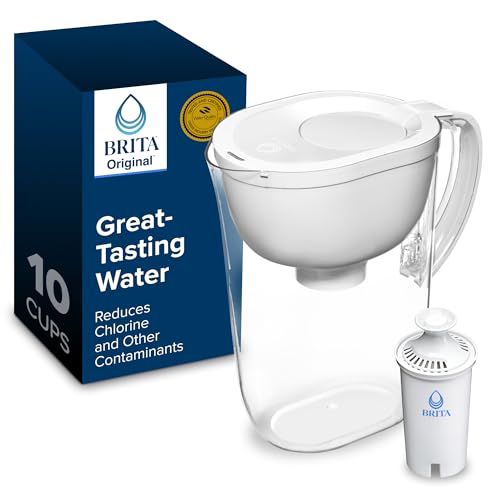
1. Brita Large 10-Cup Water Filter Pitcher
Our pick — over 4.5★ from 59,500+ verified ratings; the strongest balance of quality and price.
The crowd favorite that fits everywhere and filters fast without fussing over a budget.
The Brita Large 10-Cup earns its top spot because it fits your fridge without rearranging shelves — it measures 10.7 inches long by 5.4 inches wide by 10.1 inches tall — and holds 10 cups, enough to fill three 24-ounce reusable bottles in one go. It works right from the start, and you can find replacement filters at nearly any grocery store. Buyers report the simple setup and consistent taste improvement.
Water quality is where this pitcher delivers. It is WQA and NSF/ANSI certified to reduce chlorine taste and odor, plus mercury, copper, zinc, and cadmium. What wins people over is the taste — the new cap design uses an inset lid that stops the old spills and cap-loss frustration, and the filter removes that swimming-pool chlorine note completely. Owners mention their coffee tastes noticeably better after switching. The Standard filter lasts 40 gallons (about two months), but you can swap to the Longlast filter and stretch it to 120 gallons or roughly six months between changes.
One honest trade-off: at 2.2 pounds, the pitcher gets noticeably heavier when full, and a few owners found the replacement-reminder stickers hard to peel. But with nearly 60,000 owners averaging a 4.6-star score, the consensus is clear — this is the refrigerator-friendly, easy-to-fill, trusted-name pitcher that removes the guesswork from tap water.
Why It Wins
- Nearly 60,000 reviews at 4.6 stars — the most-trusted jug in the category
- Space-saving fridge fit (10.7″ x 5.4″ x 10.1″)
- Two filter options: Standard 40-gal / Longlast 120-gal
The Fit Note
- Plastic body — not the choice if you want glass or metal
- Lid sticker for filter reminders is small and fiddly
Grab this if: you want a proven, no-surprises pitcher that fits the fridge door and comes from a brand with a massive filter refill pipeline at any grocery store.
Think twice if: you need plastic-free materials or are after maximum contaminant removal like fluoride or PFAS — those require a more advanced (and pricier) filter.
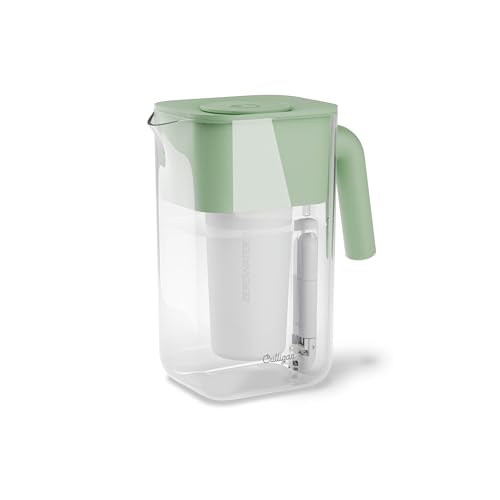
2. Culligan with ZeroWater Technology 10-Cup Pitcher
The only pitcher in this lineup that shows you exactly what is left in your water — and aims for zero.
This pitcher takes a radically different approach: instead of just filtering out taste, the Culligan with ZeroWater Technology uses a 5-stage filter that removes 99.9% of dissolved solids. The proof is built right into the lid — a TDS meter that measures total dissolved solids instantly. When the meter reads 0, your filter is pulling virtually everything out. It is IAPMO certified to reduce lead, total PFAS (forever chemicals), mercury, fluoride, and chlorine.
The real-world nuance is filtration speed. Customers note it filters slower than a Brita — that is the trade-off for the depth of filtration. The slide-open lid and built-in tester are genuine quality-of-life upgrades, and the 10.5-inch height fits most mini fridges without a struggle. But the honest durability caution: a small number of reviewers point out the handle breaking under normal use or the lid detaching. Two pitchers in one home reportedly failed after two weeks, with TDS readings jumping from under 6 ppm to 235 ppm.
If your tap water has measurable dissolved solids or if testing your water is part of your daily habit, this pitcher gives you data, not just filtered water. The 10-cup capacity holds 80 fluid ounces, and the design (at 9.5 inches long by 5 inches wide) slides forward on a countertop without dominating it.
The Big Win
- Built-in TDS meter gives real-time water quality feedback
- 5-stage filter removes 99.9% of dissolved solids, including PFAS
- Space-saving profile (9.5″ x 5″ x 10.5″) for small fridges
The Honest Catch
- Slower flow than standard pitchers — worth the wait for purity
- Durability reports vary; some units develop handle or lid issues
The right pick for: anyone who wants to know exactly what is — or is not — in their water, and who values zero TDS over fast pour speed.
Pass if: you need a fast-flow pitcher for a busy household or are concerned about durability reports at this price tier.
3. Waterdrop PT-09W 10-Cup Large Glass Water Filter Pitcher

A glass-bodied pitcher that pours faster than anything else here without sacrificing certification depth.
If waiting for water to trickle through drives you crazy, the Waterdrop PT-09W is your answer. That is about ten times faster than standard pitchers, which can take up to 10 minutes for the same volume. The glass body is the headline: high-quality, non-toxic, and sustainable, though it does have a sturdy plastic inner liner, so it is not fully glass inside.
The 5-stage filtration uses carbon fiber, ion exchange resin, and activated carbon block to reduce chlorine, mercury, copper, cadmium, and PFOA/PFOS. It is NSF/ANSI 42 certified for chlorine reduction and taste, NSF/ANSI 53 certified for mercury reduction, and NSF/ANSI 372 certified for lead-free materials (containing less than 0.25% lead). Each filter handles 100 gallons or about two months. The trade-off: the system does not lower TDS value, so if you are after pure-zero readings, the Culligan above does that better.
Buyers love the glass construction for eliminating plastic taste, but the consensus is honest — it is heavy. At 1.69 kilograms, full it requires a two-handed pour for some. A few owners mention needing to reconfigure fridge shelves to accommodate the 9.72-inch height. The water quality feedback is emphatically positive, however: chlorine taste and smell vanish, and the filtration speed stays consistent fill after fill.
Speed meets glass: The 8.5 oz/min flow rate and NSF/ANSI 53 certification make this the best pick for anyone who wants fast filtered water in a plastic-free body.
The weight trade-off: At 1.69 kg (roughly 3.7 lb) full, it demands a stronger pour grip — and requires hand washing (not dishwasher safe).
Reach for this if: you want glass over plastic, fast flow above all else, and enjoy the reassurance of third-party NSF certifications.
skip it if: your tap water has high TDS (the filter does not reduce dissolved solids) or if you need dishwasher-safe cleaning.
4. Epic Water Filters Pure Filter Pitcher
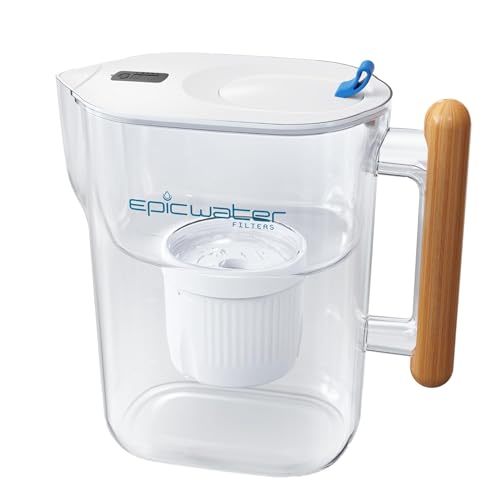
A wide-net filter that runs four times longer than standard pitchers while keeping beneficial minerals in the water.
The Epic Pure Pitcher is built for people who want one filter to do a lot of heavy lifting. Its solid carbon block filter — 6 millimeters thick — is designed and tested to remove chlorine, lead, PFAS, 1,4-Dioxane, Haloacetic Acids, fluoride, and chloramine, while leaving healthy trace minerals like calcium and magnesium in the water. The manufacturer claims it catches 2,000% more contaminants than leading pitcher filters. The filter lasts 150 gallons, which at four times the standard lifespan means roughly 90 days per cartridge. A built-in LED timer counts down from 90 days on the lid so you never guess when to swap.
The real-world feedback is split. Water quality gets consistent praise — owners say water feels smooth and tastes fresh, and it effectively removes chloramine. But the filtration speed is slow; some shoppers say it takes hours to process a full pitcher. Leakage and the flip-top lid causing dribbles are recurring mentions. The pitcher stands 12 inches tall by 8 inches long, which is taller than the Brita or the Waterdrop, so check your fridge shelf clearance. The lid also has a reported tendency to dislodge during pouring if the reservoir is not seated correctly.
The Epic Pure is for you if your tap water has a broad mix of contaminants — especially fluoride and chloramine — and you are okay with a slower filter pace. Each filter lasts 150 gallons, far longer than the Brita’s 40-gallon standard filter, so you replace it less often. pass on it if you want fast flow; the Epic Pure filters at a noticeably slower rate than the Brita Large 10-Cup.
Broad coverage, steady drip: The 150-gallon filter life and fluoride/chloramine removal set it apart, but owners consistently flag slow filtration speed as the daily friction point.
Best suited for: households with city tap water containing fluoride, chloramine, or lead, and who value fewer filter changes over quick refills.
Better options if: you need fast flow or worry about lid security during a hurried pour — the Waterdrop or Brita are more forgiving in daily use.
5. Clearly Filtered Filtered Water Pitcher
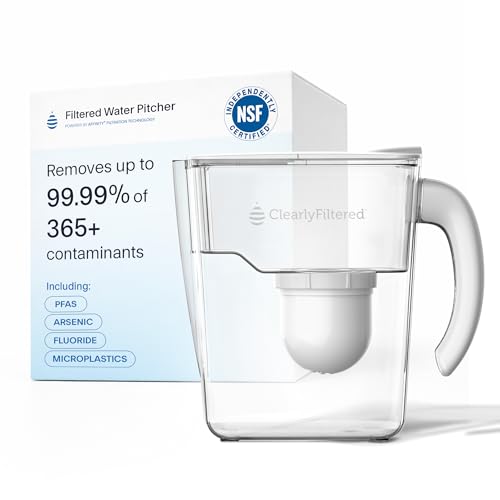
This pitcher targets over 365 contaminants — fluoride, lead, PFAS, microplastics — and lab-confirms the removal.
The Clearly Filtered pitcher is the top choice when you do not want to compromise on the breadth of what is removed. Its proprietary Affinity Filtration Technology uses ionic binding to capture up to 99.99% of 365+ contaminants, including fluoride, lead, PFAS/PFOA, arsenic, microplastics, chlorine, and perchlorate — while preserving beneficial minerals. It is NSF certified to NSF/ANSI 42 (chlorine taste and odor) and NSF/ANSI 372 (lead-free materials), and independently tested by EPA-accredited laboratories for claims beyond the certification. The 80-ounce capacity (about 10 cups) holds enough for a family in one fill.
The difference from the Epic above is that this filter targets more contaminants and includes microplastics, which the Epic does not explicitly mention. But both share the same reality: filtration speed is slower than a standard Brita. Owners note that while the taste improvement is dramatic — one lab test confirmed fluoride dropping from 0.5 ppm to undetectable — the filter takes about 17 minutes per pitcher. The medical-grade Tritan plastic body is BPA-free, BPS-free, and non-leaching. The redesigned reservoir fixes earlier swiveling complaints, and the ergonomic handle feels solid in hand.
The honest limits: the filter lasts 100 gallons (about four months), which is shorter than the Epic’s 150 gallons. A minority of buyers report minor leakage and report the top reservoir can feel loose, though the brand’s customer service gets good marks for responsiveness.
The Achievement
- Targets 365+ contaminants including microplastics — the broadest filter here
- Lab-confirmed fluoride removal (0.5 ppm to undetectable)
- NSF certified to ANSI 42 and 372
The Everyday Reality
- Filtration takes roughly 17 minutes per full pitcher
- Filter replacement costs add up at 100-gallon intervals
Choose this when: your water quality concern is broad — not just taste but fluoride, PFAS, microplastics — and you are willing to wait for the clean.
Look elsewhere if: you want fast flow for a busy kitchen or prefer a filter that lasts longer between swaps on a tighter budget.
6. Aarke Purifier – Glass & Stainless Steel Pitcher

A Swedish-designed glass-and-steel pitcher that cuts plastic waste down to nearly zero.
The Aarke Purifier is the aesthetic outlier in this lineup — designed in Sweden by industrial designers, built from glass and stainless steel, and using a patented refillable stainless steel filter cartridge rather than disposable plastic cartridges. You pour loose granules into the steel filter tank yourself; a bag of Pure granules filters 120 liters of water, replacing hundreds of single-use bottles. The large model holds 2.8 liters (about 7 cups of filtration capacity) and stands 9.8 inches tall by 5.3 inches wide — it is meant to sit on a countertop as much as in a fridge.
The water results get strong praise. Owners mention the filtration takes about one to two minutes per fill and the taste is fantastic, with no chlorine or plastic residuals. The glass carafe keeps water noticeably colder on the counter. The refillable filter system is the eco-friendly centerpiece: instead of tossing a cartridge, you simply refill the steel basket with fresh granules. The downside is that the granules are only sold by Aarke and the pouches are not the cheapest. A handful of owners had the initial filter system fall apart, but the brand’s customer support replaced it free and fast.
The glass body is sturdy but not indestructible — one owner reported it shattered after a hard drop onto a vinyl floor. The lid underside is plastic, which a few buyers found disappointing in an otherwise metal-glass product. Still, for anyone tired of disposable plastic filter cartridges, this is the most sustainable option here by a wide margin.
Refillable, not replaceable: The stainless steel filter tank and glass carafe eliminate single-use plastic from your pitcher — a genuinely different approach than every other product here.
The nuance: Filter granules are proprietary and expensive; the glass body requires careful handling.
Best if: your priority is reducing plastic waste entirely, you value a beautiful countertop object, and you do not mind a manual filter-fill routine.
Avoid if: you need an NSF-certified removal list for specific contaminants (Aarke does not certify to those standards) or if your household is hard on glass pitchers.
7. LARQ PureVis 3-in-1 Water Pitcher
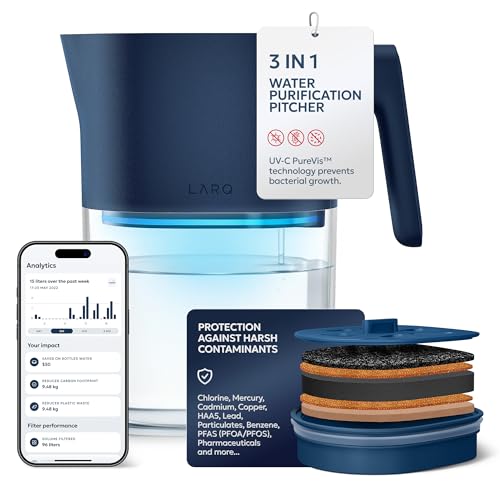
A pitcher that uses UV light to keep water pure between refills and tracks your intake via an app.
The LARQ PureVis is not just a filter — it is a 3-in-1 system that combines a filter with UV purification and app-based hydration tracking. The built-in UV-C light sanitizes the water and the pitcher interior between fills, preventing bacterial growth even if the pitcher sits on the countertop for a day. The plant-based Nano Zero filter reduces chlorine, PFAS, PFOS, mercury, cadmium, copper, lead, benzene, and pharmaceuticals, filtering up to 60 gallons per cartridge — roughly two months of daily use. The LARQ app connects via Bluetooth to track how much you drink.
The water taste feedback is emphatic. Buyers describe it as “like spring water” and report it eliminates the metallic or chlorinated taste completely. The self-cleaning UV technology is the standout difference: while every other pitcher here relies solely on passive filtration, the LARQ actively prevents microbial growth inside the reservoir. The design is sleek and compact at 10 inches by 9.37 inches by 10 inches, and it comes with a 1-year warranty.
The honest compromises: the filter lifespan is shorter than many — 60 gallons versus 100 or 150 on competitors — and the replacement filters are proprietary. The build quality gets mixed marks; some customers note parts warping after washing. And at this price point, you are paying as much for the UV technology and smart features as for the filtration itself. The plastic body (BPA-free, phthalate-free, food-grade) is well made but is still plastic, not glass.
The Tech Edge
- UV-C light actively sanitizes between refills — no other pitcher here does this
- App tracks hydration and filter life
- Reduces PFAS, lead, mercury, pharmaceuticals, and microplastics
The Trade-Offs
- 60-gallon filter life is shorter than mid-range competitors
- Premium price for UV and smart features — consider if you will actually use the app
Best fit for: tech-savvy households that leave the pitcher on the counter and want active sanitation between fills, plus hydration tracking.
Not the pick if: you want maximum filter life per dollar, prefer glass over plastic, or just need a simple filter without an app.
Understanding the Specs
NSF/ANSI Certifications
NSF/ANSI 42 covers aesthetic effects — chlorine taste and odor reduction. NSF/ANSI 53 covers health effects like lead, mercury, and PFAS. A pitcher that lists “NSF/ANSI 53” has been independently tested against that standard; one that says “tested to NSF standards” may not have passed the certification protocol. Always look for the specific standard number to know what contaminants a filter truly removes.
Filter Lifespan (Gallons vs. Months)
Manufacturers often state lifespan in months (e.g., “lasts 2 months”), but the real measure is gallons. A 40-gallon filter used by two people daily will run out before two months; a 150-gallon filter used by one person may stretch six. Budget-priced standard filters cost less per cartridge but need replacing three to four times as often as a premium long-life filter. Multiply the cartridge price by the number of replacements per year to know your actual cost.
Flow Rate (Ounces per Minute)
Standard pitchers filter at roughly 0.5 to 1 ounce per minute, meaning a full fill takes 5 to 10 minutes. High-flow filters like the Waterdrop PT-09W hit 8.5 oz/min — a cup in under a minute. Faster flow generally means less restriction, which can mean less contaminant removal. The trade-off is always speed versus reduction depth.
Material: Plastic, Glass, or Metal
BPA-free plastic (Tritan or standard) is the most common — lightweight, shatterproof, and fridge-friendly. Glass eliminates plastic taste and leaching concerns but is heavier and can break. Stainless steel interior components (as in the Aarke) prevent plastic contact with water but are rarer and pricier. Materials affect taste, durability, and sustainability equally.
FAQ
Will a water filter pitcher remove fluoride?
How often should I replace the filter?
What does a TDS meter tell me that a taste test does not?
Do glass pitchers filter better than plastic ones?
Can I put a water filter pitcher in the refrigerator door?
What is the difference between NSF/ANSI 42 and NSF/ANSI 53?
How long does a filter pitcher take to fill a full glass?
Will a water filter pitcher remove PFAS (forever chemicals)?
Can I use a filter pitcher with well water?
What does “BPA-free” mean in a pitcher?
Final Thoughts: The Verdict
For most people, the best at home water filter pitcher is the Brita Large 10-Cup — it fits your fridge, holds 10 cups, and you can buy replacement filters at any retailer. If you prefer glass and the fastest flow in this lineup, choose the Waterdrop PT-09W. For the widest contaminant coverage — including fluoride, lead, and microplastics — the Clearly Filtered Pitcher is the one to buy.
How We Picked
We do not accept paid placement. Every pick is matched to a real buyer and a real use-case; we do not hands-on test units.
Sources & Methodology
Specifications: manufacturer listings and product documentation. Review insights: verified customer reviews, as of July 2026. Pricing: not shown on this page (it changes often); check the current price via the retailer link.
As an Amazon Associate, Snuggy Mom earns from qualifying purchases. This does not affect which products we feature.